Dropshipping continues to attract new entrepreneurs and established merchants alike. The global dropshipping market was valued at $351.8 billion in 2024 and is projected to surpass $1.25 trillion by 2030 (Grand View Research, 2024). More than one in three online stores uses dropshipping as their primary fulfillment model (Statista, 2024).
The reason is straightforward: you sell products without holding inventory, and your supplier ships directly to the customer. But the model only works when your app handles the operational complexity- finding reliable suppliers, automating orders, keeping prices and stock levels current, and getting products to customers quickly.
This guide covers the 10 best dropshipping apps for Shopify in 2026, with a comparison table, niche-specific recommendations, a free plan breakdown, and a common mistakes section most lists leave out.
Table of Contents
What Is a Shopify Dropshipping App and Why Do You Need One?
A Shopify dropshipping app connects your store to one or more suppliers. When a customer places an order, the app forwards it to the supplier, who packs and ships it directly to the customer. You collect the retail price; the supplier charges you the wholesale cost. The difference is your margin.
Without an app, running dropshipping on Shopify means manually forwarding orders, tracking shipments, and monitoring stock levels across supplier websites. That is not scalable past a handful of daily orders. A good dropshipping app automates all of it.
What to Look for in a Shopify Dropshipping App
- Supplier network: Where are the suppliers based? US and EU suppliers offer faster shipping but higher costs. AliExpress and Chinese suppliers offer lower prices but longer delivery times (typically 2 to 4 weeks).
- Automation level: Does the app auto-forward orders, update tracking, and adjust prices when suppliers change them? Higher automation means less manual work as your volume grows.
- Inventory sync accuracy: Out-of-stock products that still appear available will generate orders you cannot fulfill. Look for real-time stock sync between the supplier and your Shopify store.
- Product import tools: Can you import products with one click and customize titles, descriptions, and prices before publishing? Quality import tools save hours of setup time per product.
- Pricing model: Some apps charge monthly fees; others are free to install but charge per order or take a commission. Calculate total cost at your expected order volume before committing.
- Branding options: Can you add your logo to packaging, invoices, and shipping labels? Branded fulfillment builds customer loyalty even when you are not handling the package.
- Rating and review count: Apps with thousands of reviews give you much more reliable signal than those with fewer than 100. A high rating on a low review count can be misleading.
10 Best Dropshipping Apps for Shopify in 2026
Quick comparison before the full breakdown:
| App | Category | Free Plan | Pricing | Best For | Rating |
| DSers | AliExpress dropshipping | Yes | Free to $19.90/mo | AliExpress + bulk ordering | 5.0/5 (30,000+ reviews) |
| Zendrop | US supplier | Yes | Free to $49/mo | Fast US shipping and branding | 4.8/5 (10,000+ reviews) |
| Spocket | US and EU suppliers | Yes | Free to $39.99/mo | US and EU product sourcing | 4.7/5 (4,000+ reviews) |
| CJ Dropshipping | Global sourcing | Yes (free) | Free (pay per order) | Custom sourcing and variety | 4.9/5 (9,000+ reviews) |
| AutoDS | Full automation | No | From $26.90/mo | Automated multi-supplier stores | 4.9/5 (10,000+ reviews) |
| Printful | Print-on-demand | Yes (free) | Free (pay per order) | Custom branded apparel and goods | 4.5/5 (7,000+ reviews) |
| Syncee | Multi-supplier marketplace | Yes (browse only) | From $29/mo | 6M+ products, US and EU focus | 4.7/5 (1,700+ reviews) |
| Printify | Print-on-demand | Yes | Free to $29/mo | Lower per-unit POD costs | 4.7/5 (7,000+ reviews) |
| DropCommerce | North American suppliers | Yes (browse only) | From $19/mo | NA-only fast shipping | 4.5/5 (400+ reviews) |
| Inventory Source | Supplier data feed | Yes (feeds only) | From $99/mo | 230+ pre-integrated suppliers | 3.7/5 (100+ reviews) |
1. DSers — Best Shopify Dropshipping App for AliExpress
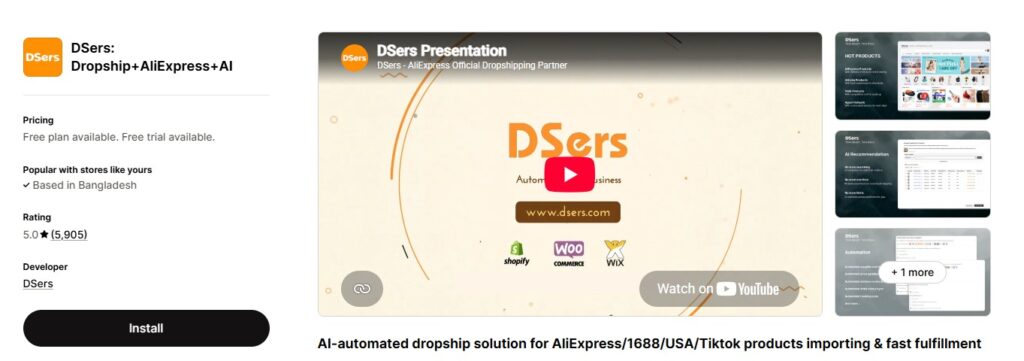
DSers is the official AliExpress dropshipping partner for Shopify and the most widely used dropshipping app in the world, with over 30,000 five-star reviews. It replaced Oberlo as the go-to AliExpress solution when Shopify retired Oberlo in 2022.
The standout feature is bulk order placement. Instead of placing orders one at a time, DSers lets you process hundreds of orders with a single click, all forwarded to the right AliExpress suppliers automatically. Its supplier optimizer also scans for the best supplier for each product based on price, ratings, and shipping speed.
- Bulk order processing: place hundreds of orders in one click
- Supplier optimizer finds the best AliExpress supplier per product automatically
- Variant mapping links your Shopify variants to specific supplier variants
- Automatic price and stock updates when supplier data changes
- Multi-store support to manage multiple Shopify stores from one account
Pricing: Free plan available. Basic plan $19.90/month, Advanced $19.90/month, Pro $49.90/month. Rating: 5.0/5 (30,000+ reviews).
Best for: Merchants sourcing from AliExpress who need efficient bulk order processing and automatic supplier management.
2. Zendrop — Best for Fast US Shipping and Branded Fulfillment
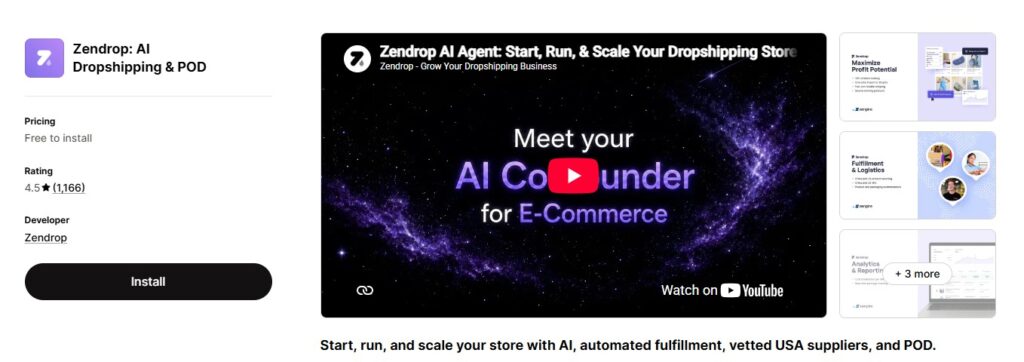
Zendrop is built around solving the two biggest complaints about traditional dropshipping: slow shipping and no branding. It operates US-based warehouses for fast domestic fulfillment (5 to 10 days), offers branded packaging with your logo, and handles custom invoicing automatically.
Zendrop also supports subscription boxes and custom product bundles, making it useful for stores that want to move beyond single-item orders.
- US-based warehouses with 5 to 10 day domestic delivery
- Branded packaging, invoicing, and thank-you cards
- Auto-fulfillment when orders come in
- Custom product bundles and subscription box support
- Product sourcing on request if a specific item is not in the catalog
Pricing: Free plan available (limited products). Pro plan $49/month, Plus $79/month. Rating: 4.8/5 (10,000+ reviews).
Best for: US-focused stores that need fast shipping and want branded packaging without managing their own warehouse.
3. Spocket — Best for US and EU Supplier Products
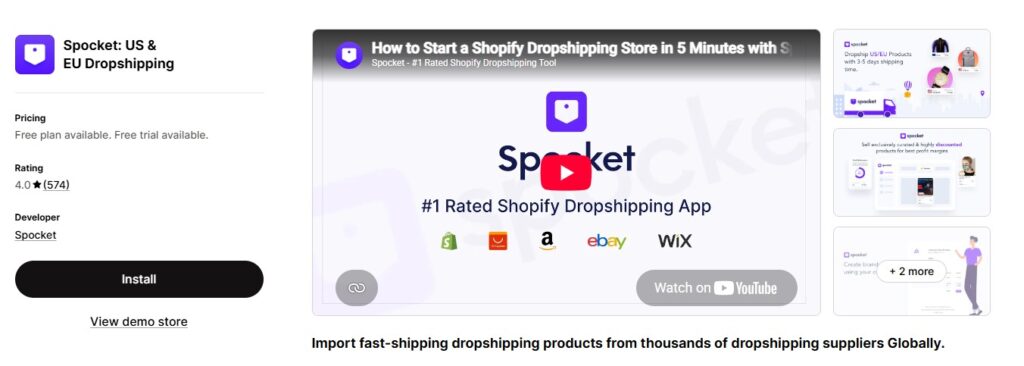
Spocket focuses on pre-vetted suppliers based in the US and EU. This means faster shipping times than AliExpress (typically 2 to 7 days for US customers) and higher product quality standards. Most products ship with branded invoicing included.
It also lets you order product samples before listing anything in your store, which is useful for verifying quality before selling to customers.
- Pre-vetted US and EU suppliers with 2 to 7 day shipping to US customers
- Sample ordering to verify product quality before listing
- Branded invoicing with your store name and logo
- Real-time inventory and pricing updates from suppliers
- Integration with DSers for AliExpress products alongside Spocket suppliers
Pricing: Free plan (25 unique products). Starter $39.99/month, Pro $59.99/month, Empire $99.99/month. Rating: 4.7/5 (4,000+ reviews).
Best for: Stores targeting US and European customers who need faster delivery than AliExpress can offer.
4. CJ Dropshipping — Best for Product Variety and Custom Sourcing
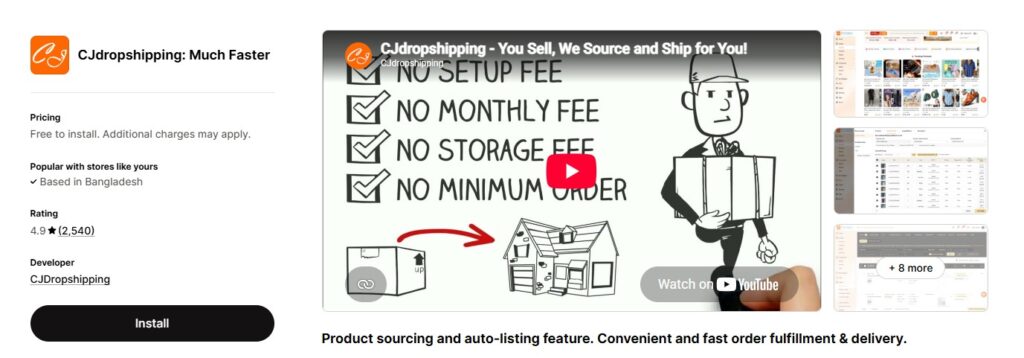
CJ Dropshipping operates warehouses across the US, Europe, and Asia, giving merchants flexible shipping options depending on the destination. It offers one of the widest product catalogs in the industry and will source custom products on request, including white-label and private-label options.
It is free to use. You pay only the product and shipping cost per order, with no monthly subscription required.
- Free to install and use, pay per order only
- Warehouses in the US, EU, and Asia for flexible shipping options
- Custom product sourcing: request any product not already in the catalog
- Print-on-demand option for custom branded products
- Product photography service available for custom items
Pricing: Free (pay wholesale cost per order). No monthly fee. Rating: 4.9/5 (9,000+ reviews).
Best for: Merchants who want a wide product selection, custom sourcing, or white-label options without paying a monthly app fee.
5. AutoDS — Best for Full Dropshipping Automation
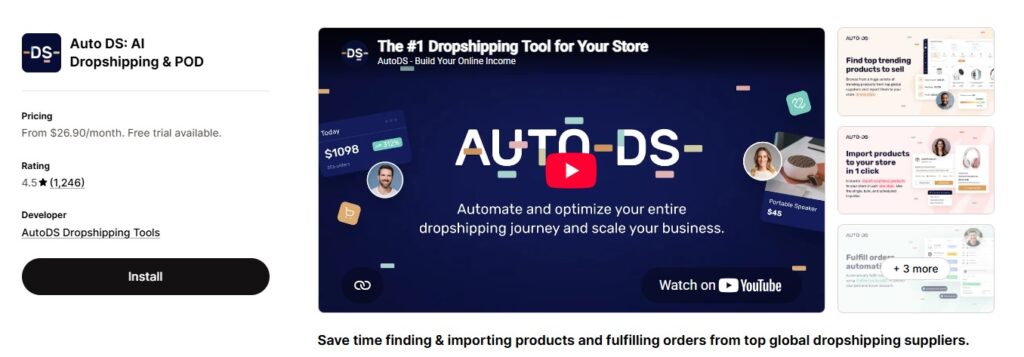
AutoDS is the most automation-heavy option on this list. It monitors supplier prices 24/7 and adjusts your Shopify prices automatically when supplier costs change. When an order comes in, AutoDS routes it to the supplier and updates the customer with tracking information, all without manual intervention.
It supports over 25 suppliers including AliExpress, Amazon, Walmart, eBay, and more, making it the best option for merchants who want to source from multiple places from a single dashboard.
- Price monitoring and automatic price adjustment when supplier costs change
- Auto-ordering and tracking update across 25+ supported suppliers
- AI-powered product research to find trending items
- Automatic stock monitoring to pause listings when suppliers run out
- Integration with TikTok Shop, Facebook Marketplace, and eBay
Pricing: No permanent free plan. Plans from $26.90/month. 14-day free trial. Rating: 4.9/5 (10,000+ reviews).
Best for: Store owners who want maximum automation and are willing to pay for it. Best for scaling stores managing large catalogs across multiple suppliers.
6. Printful — Best for Print-on-Demand Dropshipping
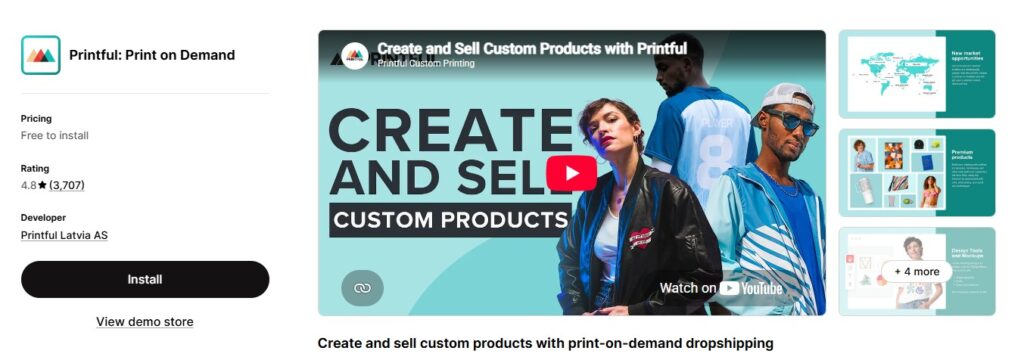
Printful handles everything for custom-printed apparel, accessories, and home goods. You upload your design, list the product in your Shopify store, and Printful prints and ships each item as orders arrive. No inventory, no minimums, no warehouse.
Products are produced in Printful’s own facilities across the US, Europe, and Mexico, which gives them strong quality control compared to third-party print networks.
- 340+ customizable products including t-shirts, hoodies, hats, mugs, and posters
- In-house production facilities for consistent quality
- White-label packaging and branded inserts
- Mockup generator for product photography without a photoshoot
- Warehousing option if you want to pre-stock high-volume products
Pricing: Free to install. You pay per order at production cost. Keep the margin between your retail price and Printful’s cost. Rating: 4.5/5 (7,000+ reviews).
Best for: Creators, artists, and brand builders selling custom-designed merchandise without managing inventory.
7. Syncee — Best Multi-Supplier Dropshipping Marketplace
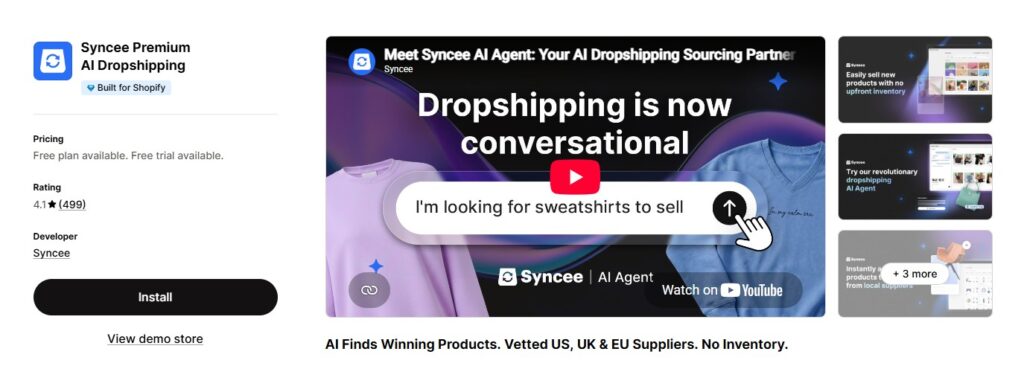
Syncee gives you access to over 6 million products from more than 12,000 suppliers, primarily based in the US, EU, UK, and Australia. It acts as a marketplace where you can browse suppliers, filter by shipping location and time, and import products directly to your Shopify store.
The platform also supports automated product data syncing, so price and stock updates from suppliers flow into your store automatically.
- 6 million+ products from 12,000+ verified suppliers
- Filter suppliers by location, shipping speed, and product category
- Automated price and inventory sync from supplier to Shopify
- Data feed support for suppliers who provide product files in CSV or XML format
- Global and regional supplier options including US, EU, and AU
Pricing: Free plan (browse only, no publishing). Basic $29/month, Pro $49/month, Business $99/month. Rating: 4.7/5 (1,700+ reviews).
Best for: Merchants looking for a wide supplier marketplace with a focus on US and EU shipping.
8. Printify — Best Print-on-Demand App for Lower Per-Unit Costs
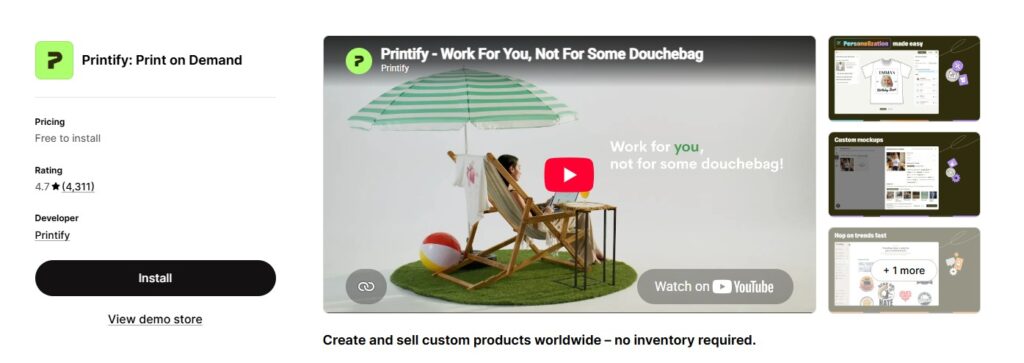
Printify works similarly to Printful but uses a network of 90+ independent print providers globally instead of its own facilities. This creates more price variation and more product options, but less consistency in quality since providers differ.
Where Printify wins is cost. The premium plan reduces per-unit costs significantly, which improves margins for high-volume sellers.
- 900+ customizable products, the widest selection of any POD app
- 90+ print providers across the US, Europe, Australia, and Asia
- Premium plan reduces per-product cost for volume sellers
- Mockup generator and product preview tools
- Choice of print provider lets you balance cost vs. quality per product
Pricing: Free plan available. Premium plan $29/month (reduces per-unit costs). Rating: 4.7/5 (7,000+ reviews).
Best for: High-volume print-on-demand sellers who want the widest product selection and need lower per-unit costs to maintain margins.
9. DropCommerce — Best for North American Supplier Products
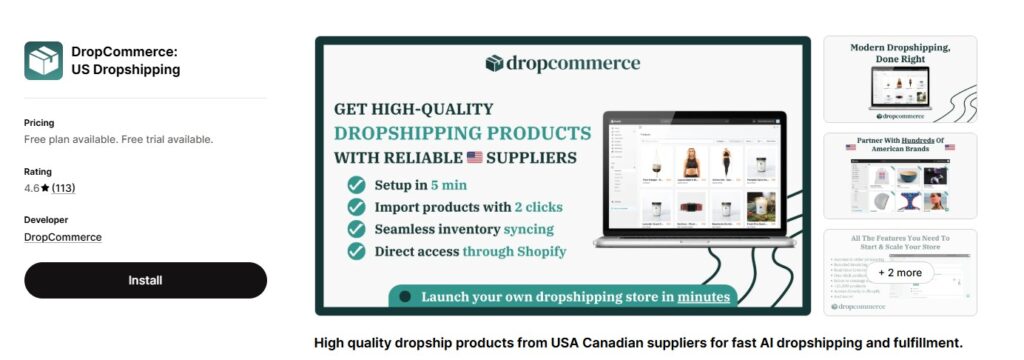
DropCommerce is a curated marketplace of North American suppliers only. Every supplier is vetted before being listed, which keeps product quality consistent. Shipping times are typically 3 to 8 days within the US and Canada.
It is a smaller catalog than Spocket or Syncee, but the focus on North American sourcing and quality vetting makes it popular with stores that compete on delivery speed and product reliability.
- 100% North American suppliers vetted for quality and reliability
- 3 to 8 day shipping to US and Canadian customers
- Branded invoicing included
- Curated catalog with a focus on unique and boutique products
- Direct communication with suppliers through the platform
Pricing: Free plan (browse only). Basic $19/month, Growth $49/month, Pro $89/month. Rating: 4.5/5 (400+ reviews).
Best for: US and Canadian stores selling to domestic customers who want faster delivery and consistent product quality from vetted suppliers.
10. Inventory Source — Best for Pre-Integrated Supplier Data Feeds
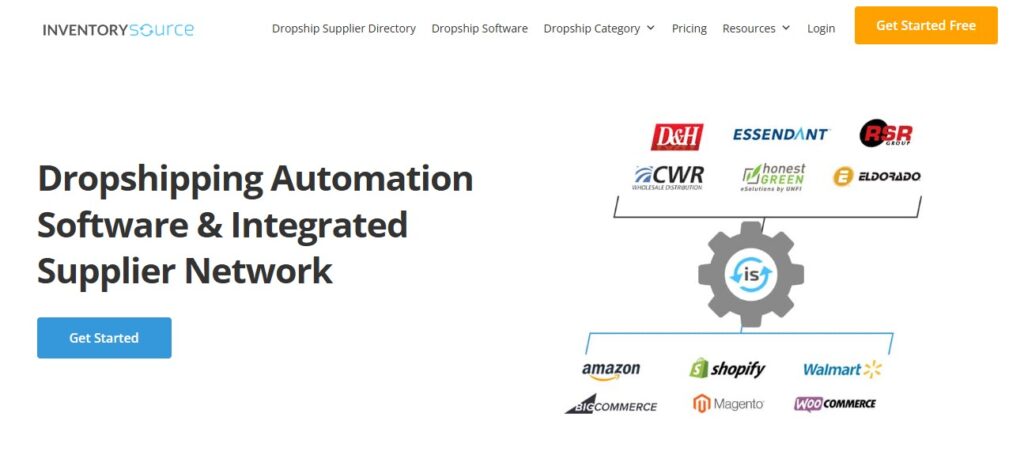
Inventory Source is built for merchants who work with established wholesale suppliers and need automated product data management at scale. It connects to over 230 pre-integrated supplier data feeds and automatically uploads products, updates stock levels, and routes orders to the right supplier.
It is the most enterprise-oriented tool on this list and is priced accordingly. It is not the right fit for new dropshippers, but for stores managing complex multi-supplier catalogs, it reduces a significant amount of manual data work.
- 230+ pre-integrated supplier data feeds across multiple categories
- Automatic product upload and catalog management from supplier files
- Order routing and tracking sync for integrated suppliers
- Full inventory automation without manual CSV imports
- Custom integrations available for suppliers not already in the network
Pricing: Free plan (data feeds only, no automation). Inventory automation from $99/month, full order automation from $199/month. Rating: 3.7/5 (100+ reviews).
Best for: Established dropshipping businesses working with large wholesale supplier catalogs that need automated product data management.
How to Keep Your Dropshipping Inventory Accurate on Shopify
One of the most common problems in dropshipping is selling a product that is actually out of stock with the supplier. The customer places an order, you forward it to the supplier, and then you find out the item is unavailable. Cancellations damage your store’s reputation and trigger payment disputes.
Most dropshipping apps include some level of inventory sync, but they only cover their own supplier network. If you source from multiple suppliers or manage any in-house stock alongside dropshipped products, keeping stock levels accurate across your entire catalog requires a separate layer of inventory management.
For Shopify stores managing mixed catalogs, FlexSync offers a practical solution. It connects Shopify inventory directly to Google Sheets with a two-way real-time sync, so you can track and update stock levels, prices, and product data across your entire catalog from a single spreadsheet. It is particularly useful for stores that receive supplier stock updates in spreadsheet format or need to bulk update prices when supplier costs change.
For more on managing Shopify inventory effectively, see: Shopify inventory management done properly.
The biggest inventory risk in dropshipping is selling an out-of-stock item. Make sure your dropshipping app syncs supplier stock in real time, and review your sync settings after any major supplier catalog change.
Which Dropshipping App Is Right for Your Niche?
Not every store needs the same app. Here is a niche-by-niche breakdown:
| Use Case | Recommended Apps | Why |
| Custom apparel and merchandise | Printful, Printify | No supplier needed. Products made when ordered. Zero inventory risk. |
| Fashion and clothing (branded) | Spocket, Zendrop, DropCommerce | US and EU suppliers with faster shipping. Better for brand-conscious buyers. |
| General and high-volume stores | DSers, CJ Dropshipping, Syncee | Access to millions of products. Lower per-unit cost. AliExpress or global warehouses. |
| Automated scaling stores | AutoDS | Handles monitoring, ordering, and tracking updates across multiple suppliers automatically. |
| Niche B2B or enterprise catalogs | Inventory Source | Pre-integrated supplier feeds for structured product data at scale. |
Free Dropshipping Apps for Shopify: What You Actually Get
Several apps advertise free plans, but the limitations vary significantly. Here is what each free tier actually covers:
- DSers free: Fully functional for AliExpress dropshipping. Covers product imports, order management, and supplier mapping. The paid plans add bulk order features and advanced automation.
- Zendrop free: Limited product access. You can browse and import but are restricted in which products you can publish. Auto-fulfillment requires a paid plan.
- Spocket free: Browse up to 25 unique products. You can view supplier details and test the import flow, but publishing to your store requires a paid subscription.
- CJ Dropshipping: Genuinely free. No monthly fee. You pay the product and shipping cost per order. Full access to the catalog, sourcing, and order management.
- Printful: Free to install and use. You pay per order. No subscription required at any scale. Your cost is the production price; your revenue is whatever you charge customers.
- Printify free: Full access to products and print providers. The free plan has no per-order discounts. Premium ($29/month) reduces per-unit costs.
- Syncee free: Browse the supplier marketplace only. You cannot publish products or automate inventory on the free plan.
- DropCommerce free: Browse only. Publishing requires a paid plan starting at $19/month.
For truly free dropshipping on Shopify with no monthly fees: CJ Dropshipping and Printful are the only options where you can run a complete store without a subscription. DSers is free with full AliExpress functionality.
Common Mistakes New Shopify Dropshippers Make
- Choosing suppliers by price alone: The cheapest supplier often has the slowest shipping or lowest product quality. Check ratings, read recent reviews, and order samples before listing anything.
- Not setting realistic shipping expectations: AliExpress shipping can take 2 to 4 weeks. If your product page says 5 to 7 days, customers will dispute the order. Be honest about delivery times from day one.
- Ignoring inventory sync settings: If your app does not sync supplier stock in real time, you will take orders for out-of-stock products. Review your sync frequency settings after installation.
- Using supplier product descriptions without editing: Supplier copy is generic, often poorly translated, and shared across hundreds of stores. Rewrite descriptions for your audience and your brand voice.
- Skipping product samples: Apps like Spocket and DropCommerce make sampling easy. Use it. Selling a product you have never seen is a fast way to generate returns and negative reviews.
- Installing multiple overlapping apps: Two AliExpress apps or two print-on-demand apps create order confusion and duplicate listings. Pick one per category and commit to it.
How to Start Dropshipping on Shopify in 5 Steps
- Choose your niche. Pick a product category with consistent demand and manageable competition. Check Google Trends and Shopify’s trending product data before committing.
- Install a dropshipping app. Match the app to your niche using the table above. Start with a free plan if available.
- Import and customize products. Use the app’s import tool to pull products into Shopify. Rewrite titles and descriptions, set your own pricing, and replace any generic imagery where possible.
- Configure inventory sync. Enable real-time stock sync in your app settings. Test it by checking whether a supplier’s stock change is reflected in your Shopify dashboard.
- Set up order automation. Enable automatic order forwarding to your supplier. Test the full flow with a sample order before opening your store to customers.
Frequently Asked Questions
What is the best free dropshipping app for Shopify?
CJ Dropshipping and Printful are the best genuinely free options. Both have no monthly subscription fees. CJ charges per order at wholesale cost; Printful charges per order at production cost. DSers also has a free plan with full AliExpress dropshipping functionality.
What is the best Shopify dropshipping app for US suppliers?
Spocket, Zendrop, and DropCommerce all focus on US-based suppliers. Spocket is the largest in terms of product selection. Zendrop has the strongest branded packaging options. DropCommerce is the most curated with strict supplier vetting. For broader context on the best Shopify apps overall, see: best Shopify apps.
How much can you make with Shopify dropshipping?
Profit margins in dropshipping typically range from 10% to 30% depending on the niche, supplier, and app costs (Shopify, 2024). Lower-margin niches (electronics, accessories) sit closer to 10 to 15%. Higher-margin niches (print-on-demand, beauty, home decor) can reach 30% or more. Your app costs and ad spend reduce the net margin further.
Can I use more than one dropshipping app on Shopify?
Yes. Many stores combine a print-on-demand app (Printful or Printify) with a supplier marketplace (DSers or Spocket). Just make sure each app manages a separate product category to avoid order routing conflicts. Review your inventory sync settings for each app separately.
What is the difference between DSers and AutoDS?
DSers focuses specifically on AliExpress and is the official Shopify partner for that platform. It is best for stores sourcing primarily from AliExpress with bulk order needs. AutoDS supports 25+ suppliers including AliExpress, Amazon, Walmart, and eBay, with more automation but a higher monthly cost. Choose DSers if AliExpress is your main supplier; choose AutoDS if you need multi-supplier automation.
What is the best print-on-demand dropshipping app for Shopify?
Printful is the better option if you prioritize consistent quality and do not mind slightly higher per-unit costs. Printify is better if you need a wider product selection or want lower per-unit costs through their Premium plan. Both are free to install with no monthly fees required.
How do I manage inventory across multiple dropshipping suppliers on Shopify?
Most dropshipping apps sync supplier stock for their own catalog. For stores combining products from multiple sources, using a spreadsheet-based inventory tool helps centralize visibility. See the guide on Shopify inventory management for a breakdown of tools that work alongside dropshipping apps.
Conclusion
The best dropshipping apps for Shopify in 2026 cover a range of use cases. DSers leads for AliExpress volume. Spocket and Zendrop serve US and EU supplier needs with faster delivery. Printful and Printify cover print-on-demand with no upfront cost. AutoDS handles the most automation. CJ Dropshipping gives the most flexibility with no monthly fee.
Start by identifying your niche and supplier preference, then match to the right app using the comparison table above. Most apps offer a free plan or free trial, so you can test before committing. For more Shopify resources, see the guides on best Shopify apps for clothing stores and best Shopify apps for jewelry stores.
