The Shopify App Store now hosts over 17,600 apps, and 87% of Shopify merchants use third-party apps to run and grow their stores. With so many options, finding the right tools can feel overwhelming.
This guide breaks down the best Shopify apps by category, covering inventory management, SEO, dropshipping, reviews, email marketing, and upsells. Each section includes at least three vetted picks with real pricing and features, so you can compare and choose with confidence.
Table of Contents
Best Shopify Inventory Management Apps
Keeping stock accurate across products, variants, and locations is one of the hardest parts of running a Shopify store. These apps take the manual work out of inventory tracking, bulk editing, and stock syncing.
Or, instead of testing hundreds of apps through trial and error, Koala Inspector allows merchants and dropshippers to bypass the guesswork by analyzing what is already working for successful competitors.
Functioning as a lightweight Chrome extension, Koala Inspector acts as an all-in-one e-commerce intelligence tool that reveals the tech stack and backend strategies behind any Shopify store with a single click. The Shopify Theme Detector by Koala Inspector solves an additional challenge – store design discovery by identifying the exact theme powering any storefront.
1. FlexSync (Top Pick ⭐)
Rating: 4.5/5 (Shopify App Store)
Free Plan: Yes, up to 500 SKUs
Paid Plans: From $9/month
FlexSync connects Shopify directly to Google Sheets with two-way sync. You can bulk edit Shopify product prices, update stock levels, and push changes back to Shopify automatically. It is one of the few apps with a genuinely useful free plan. Check out the full guide to the best Shopify inventory management apps to see how FlexSync compares to other tools.
Key Features:
- Two-way real-time sync between Shopify and Google Sheets
- Bulk edit prices, SKUs, titles, descriptions, and barcodes
- Formula automation for restocking rules and pricing logic
- Multi-location inventory management
- Metafields sync directly from a spreadsheet
- No coding required
- Built for Shopify certified
Best for: Small to mid-sized Shopify stores that manage inventory and product data from Google Sheets.
2. syncX
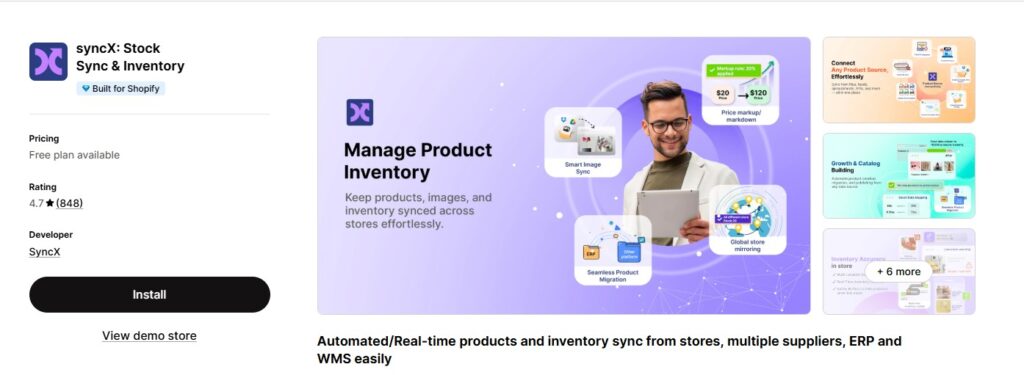
Rating: 4.7/5
Free Plan: Limited free tier
Paid Plans: From $7/month
Stock Sync is a widely used tool for pulling inventory from supplier feeds into Shopify. It supports over 25 data formats including CSV, XML, JSON, and Google Sheets, making it easy to keep stock levels updated from multiple sources.
Key Features:
- Sync from multiple supplier feeds automatically
- Scheduled and real-time update options
- Price markup and quantity rules
- Multi-location support
Best for: Stores that source products from multiple suppliers and need automated stock updates.
3. Prediko
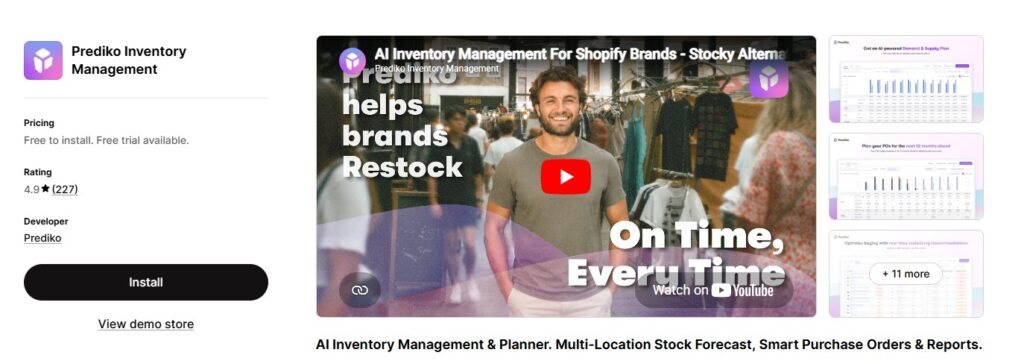
Rating: 4.9/5
Free Plan: No
Paid Plans: From $49/month
Prediko uses AI to forecast demand and automate purchase order creation. It analyzes your historical sales data to tell you what to reorder, how much, and when, reducing both stockouts and overstock.
Key Features:
- AI-powered demand forecasting
- Automated purchase order creation
- Inventory health alerts
- Sales velocity and trend tracking
Best for: Growing DTC brands that need smarter replenishment planning and want to avoid peak-season stockouts.
👉 Learn more about the Top Shopify Inventory Management Apps →
Best Shopify SEO Apps
Good SEO helps your store appear in search results when customers are actively looking for what you sell. These apps handle the technical and on-page SEO work so you can focus on running your store.
1. Plug In SEO
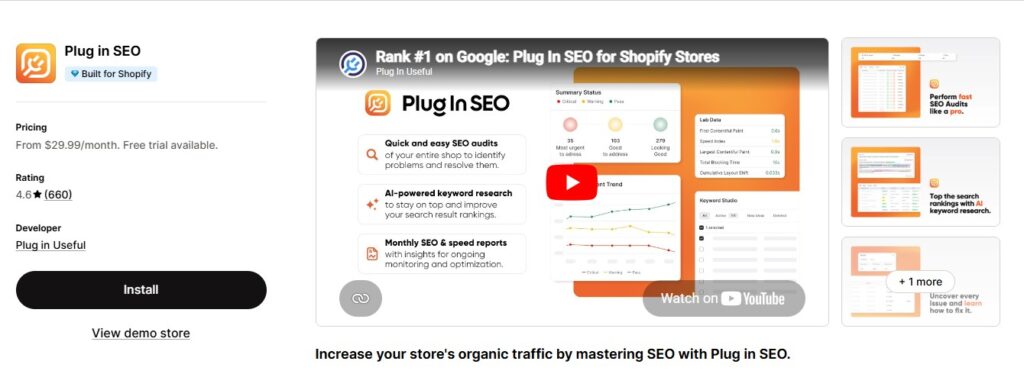
Rating: 4.6/5
Free Plan: Free plan available
Paid Plans: From $29.99/month
Plug In SEO is one of the most widely installed SEO apps on Shopify. It audits your store for common SEO issues, including broken links, missing meta tags, slow pages, and structured data errors, then gives you clear steps to fix them.
Key Features:
- Automated SEO audit and issue detection
- Meta title and description editing
- Structured data (JSON-LD) support
- Bulk SEO fixes across products and pages
- Google Search Console integration
Best for: Shopify merchants who want a clear picture of their SEO health and actionable fixes without hiring a developer.
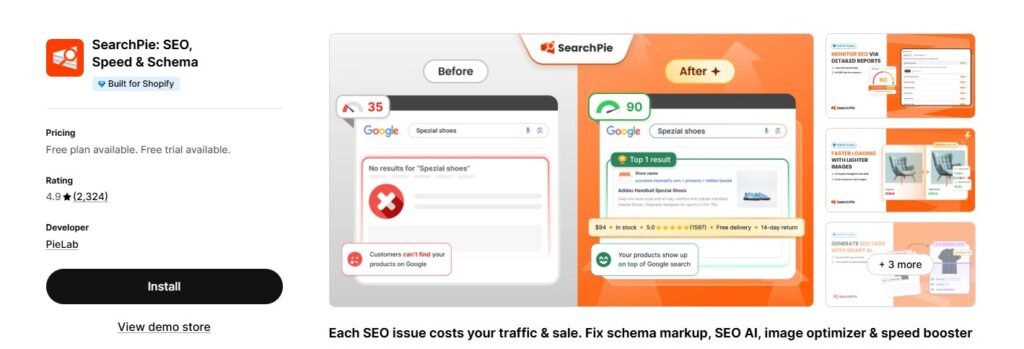
2. SearchPie SEO and Speed
Rating: 4.9/5
Free Plan: Free plan available
Paid Plans: From $39/month
SearchPie combines SEO optimization with page speed improvements. It helps you optimize meta tags, fix broken links, compress images, and improve Core Web Vitals scores, which directly affect Google rankings.
Key Features:
- Automated meta tag optimization
- Image compression and lazy loading
- Broken link detection and redirect manager
- JSON-LD structured data for products
- Keyword suggestions and tracking
Best for: Stores that want both SEO and speed improvements in one app.
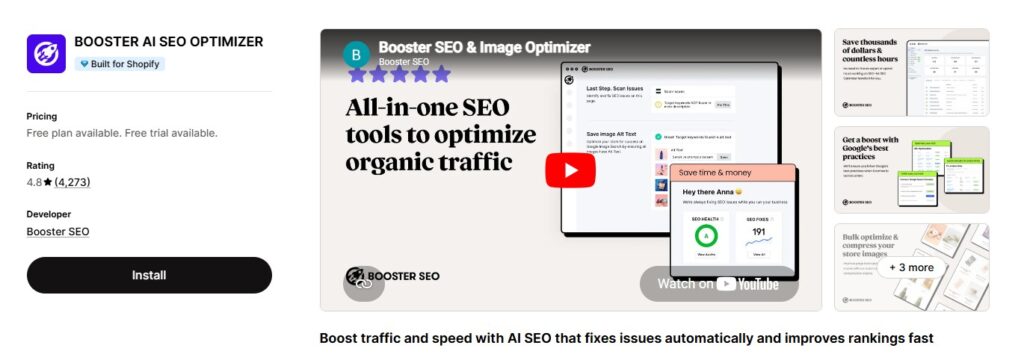
3. Booster SEO and Image Optimizer
Rating: 4.8/5
Free Plan: Free plan available
Paid Plans: From $39/month
Booster SEO focuses on image SEO and alt text automation, which is often overlooked but important for ranking in Google Image Search and improving page load times.
Key Features:
- Automated image alt text generation
- Image compression without quality loss
- Meta tag templates for bulk editing
- Broken link redirect manager
- SEO audit reports
Best for: Shopify stores with large product catalogs and image-heavy pages who want to improve rankings without manual work.
Best Dropshipping Apps for Shopify
Dropshipping apps connect your Shopify store to suppliers so you can sell products without holding inventory. These are the most reliable tools available in 2026.
1. DSers
Rating: 4.9/5
Free Plan: Free plan available
Paid Plans: From $19.90/month
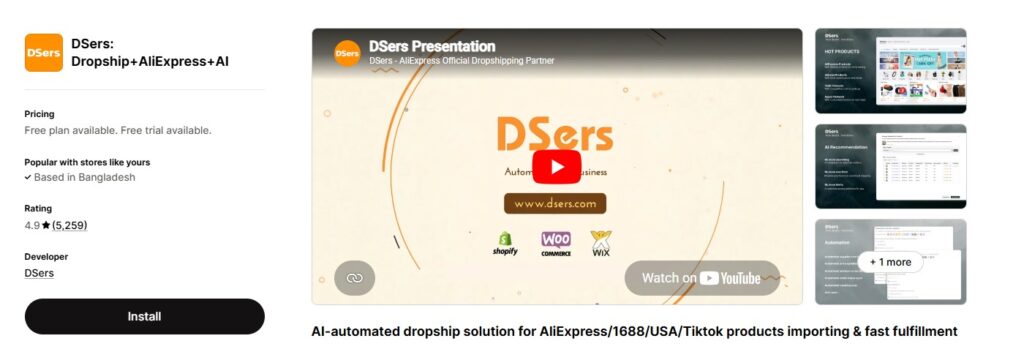
DSers is the official AliExpress dropshipping partner and the most popular dropshipping app on Shopify. It lets you import products from AliExpress, place bulk orders, and sync tracking numbers automatically.
Key Features:
- One-click product import from AliExpress
- Bulk order processing (up to 100 orders at once)
- Automatic order tracking sync
- Supplier optimizer to find the cheapest source
- Bundle and BOGO product mapping
Best for: New and established dropshippers who source products from AliExpress.
2. Spocket
Rating: 3.8/5
Free Plan: Free plan available
Paid Plans: From $39.99/month
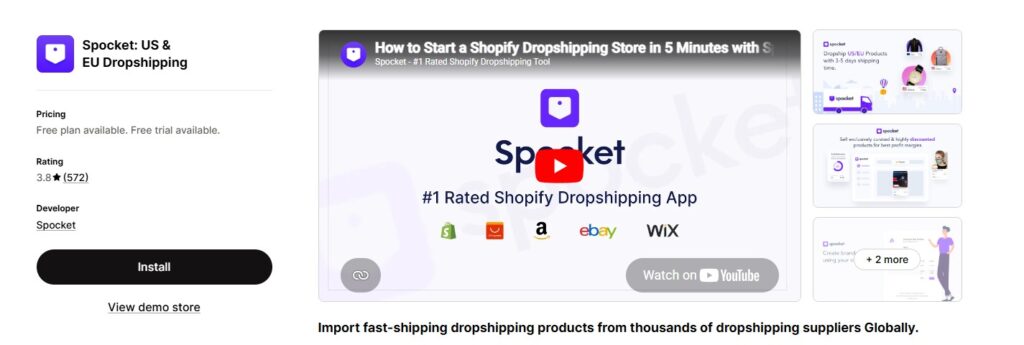
Spocket connects Shopify stores with vetted suppliers based in the US and EU. This means faster shipping times and higher-quality products compared to most AliExpress alternatives.
Key Features:
- US and EU supplier network
- 2 to 5 day shipping for domestic orders
- Branded invoicing
- Automatic inventory and price updates
- One-click product import
Best for: Dropshippers who want faster shipping and premium product quality for US or European customers.
3. Printful
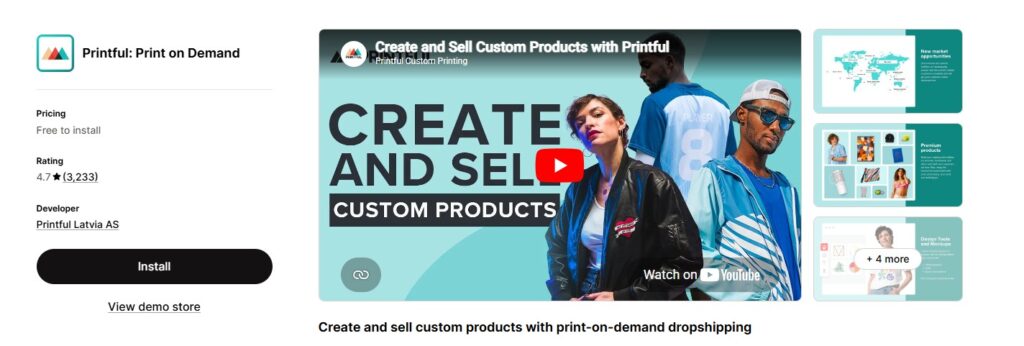
Rating: 4.7/5
Free Plan: Free to use
Paid Plans: $24.99/month
Printful is a print-on-demand dropshipping app that lets you sell custom-printed products like t-shirts, mugs, and posters without holding stock. Products are printed and shipped by Printful when an order is placed.
Key Features:
- 300+ customizable products
- No minimum order quantity
- Automatic order fulfillment and shipping
- Built-in mockup generator
- Global fulfillment centers
Best for: Creators, artists, and brand builders who want to sell custom merchandise without managing inventory.
Best Shopify Review Apps
Customer reviews build trust and directly influence purchase decisions. A good review app makes it easy to collect, display, and leverage social proof across your store.
1. Judge.me
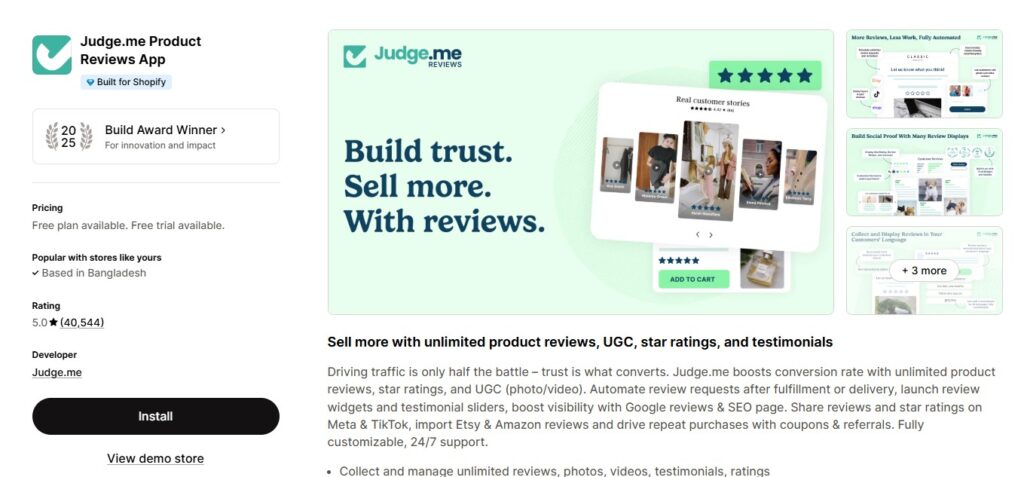
Rating: 5.0/5
Free Plan: Free plan available
Paid Plans: From $15/month
Judge.me is the most widely used review app on Shopify, installed on over 20% of Shopify stores worldwide (Uptek, 2026). It collects reviews via automated email requests and displays them with rich star ratings, photos, and Q&A sections.
Key Features:
- Automated review request emails and SMS
- Photo and video review collection
- Google Shopping and rich snippet integration
- Unlimited reviews on the free plan
- Review import from other platforms
Best for: Any Shopify store looking for a reliable, feature-rich review app at a low cost.
2. Loox
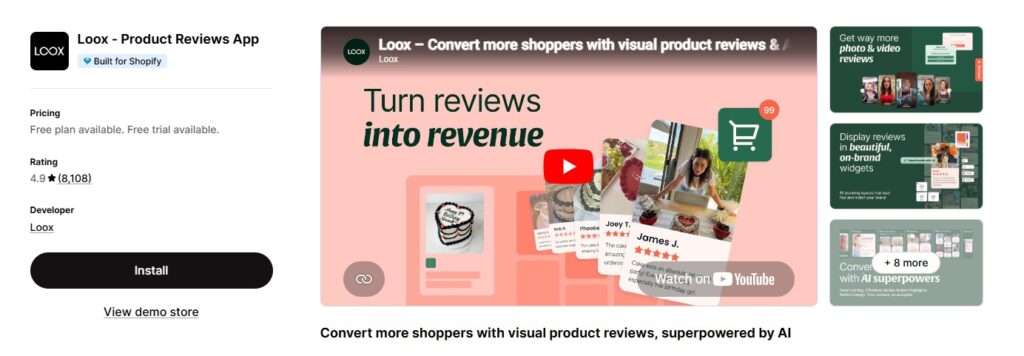
Rating: 4.9/5
Free Plan: No
Paid Plans: From $9.99/month
Loox specializes in photo and video reviews. Its visual-first approach works well for stores selling products where appearance matters, such as fashion, beauty, or home goods.
Key Features:
- Photo and video review requests via email
- Visual review widgets (carousels, popups, sidebars)
- Referral program built in
- Google Shopping integration
- Review import from AliExpress and Amazon
Best for: Stores where visual social proof drives conversions, such as fashion, beauty, and lifestyle brands.
3. Yotpo
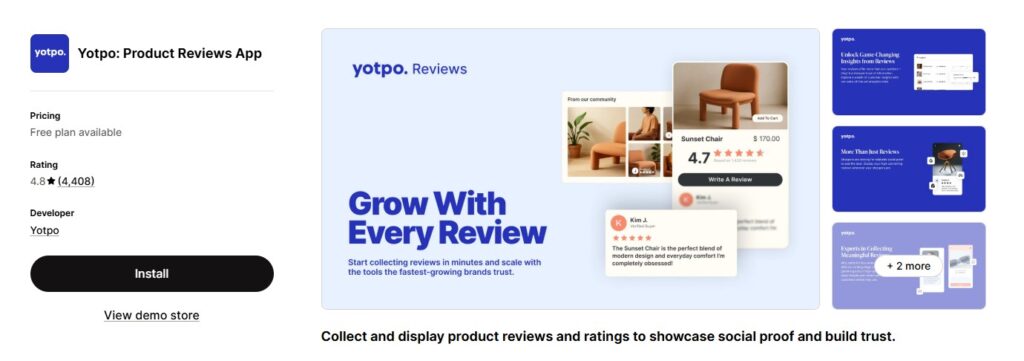
Rating: 4.8/5
Free Plan: Free plan available
Paid Plans: From $15/month
Yotpo is a premium social proof platform that combines reviews, ratings, loyalty programs, and SMS marketing in one suite. It is one of the most feature-complete options available, though it is best suited for mid-to-large stores.
Key Features:
- Automated review and rating collection
- Q&A and community content features
- Google and Meta Shopping integrations
- Loyalty and rewards program (paid)
- SMS marketing integration
Best for: Growing or enterprise Shopify stores that want reviews, loyalty, and SMS under one platform.
👉 Learn about the best AI chatbot for Shopify →
Best Email Marketing Apps for Shopify
Email marketing delivers one of the highest returns of any ecommerce channel. These apps help you automate campaigns, segment your audience, and recover lost revenue from abandoned carts.
1. Klaviyo
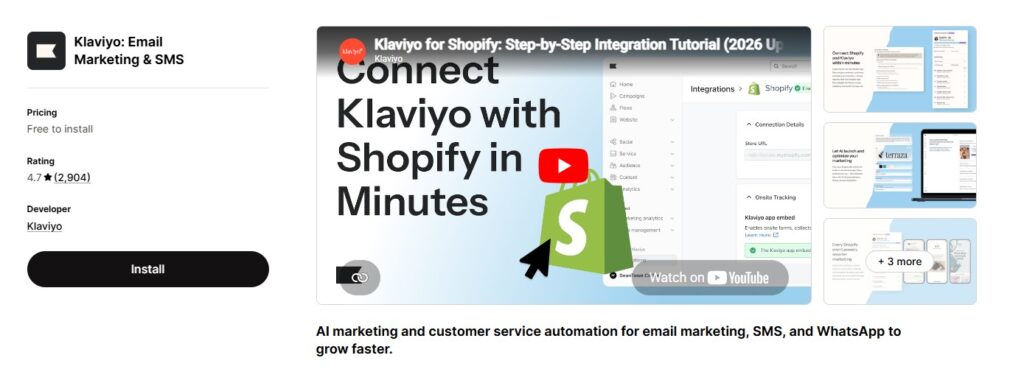
Rating: 4.7/5
Free Plan: Free up to 500 contacts
Paid Plans: From $15/month
Klaviyo is the most popular email marketing app on Shopify, used by 14.2% of all Shopify stores worldwide (Uptek, 2026). It is built specifically for ecommerce, with deep Shopify data integration that powers highly targeted campaigns based on purchase behavior, browsing history, and customer segments.
Key Features:
- Advanced segmentation based on Shopify data
- Pre-built automation flows (abandoned cart, welcome, post-purchase)
- SMS marketing included
- A/B testing for emails and flows
- Predictive analytics for CLV and churn risk
Best for: Shopify stores ready to invest in serious email marketing with deep automation and segmentation.
2. Omnisend
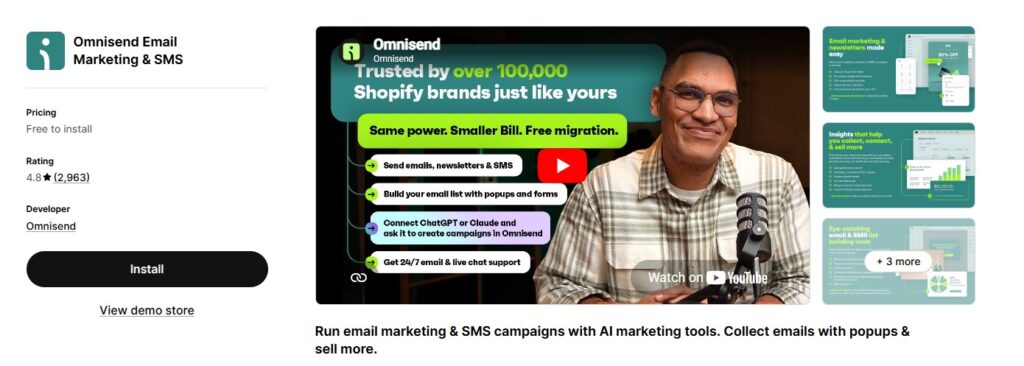
Rating: 4.8/5
Free Plan: Free up to 500 emails/month
Paid Plans: From $16/month
Omnisend is a strong Klaviyo alternative built for ecommerce. It offers email, SMS, and push notifications in one platform with an easy drag-and-drop editor and pre-built ecommerce automation workflows.
Key Features:
- Email, SMS, and push notifications in one tool
- Pre-built automation: abandoned cart, browse abandonment, welcome series
- Drag-and-drop email builder
- Segmentation based on shopping behavior
- Campaign booster (auto-resend to non-openers)
Best for: Small to mid-sized Shopify stores that want multi-channel automation without the complexity of Klaviyo.
3. Privy
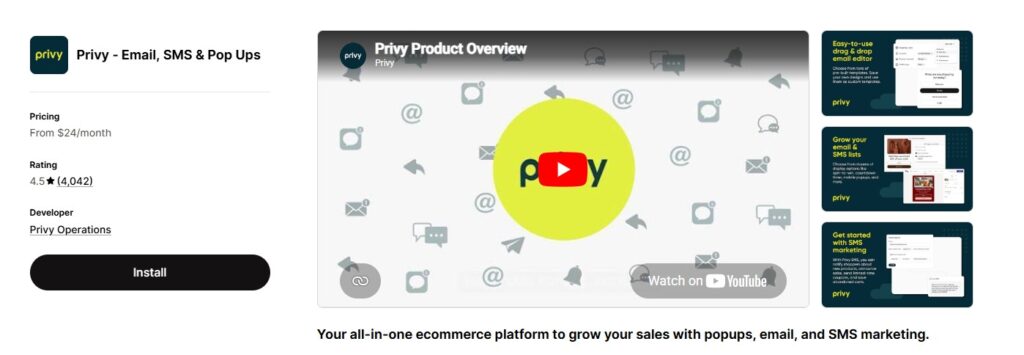
Rating: 4.5/5
Free Plan: Free plan available
Paid Plans: From $24/month
Privy combines email marketing with exit-intent popups, spin-to-win displays, and embedded forms. It is a good all-in-one tool for growing your email list and recovering abandoned carts at the same time.
Key Features:
- Exit-intent and timed popup builder
- Abandoned cart email automation
- Coupon-based email capture
- Spin-to-win and flyout displays
- Basic email campaign sending
Best for: New and growing Shopify stores that want to build their email list and recover carts with one simple tool.
Best Upsell Apps for Shopify
Upsell and cross-sell apps increase your average order value without needing more traffic. These tools surface relevant product offers at the right moment in the buying journey.
1. ReConvert
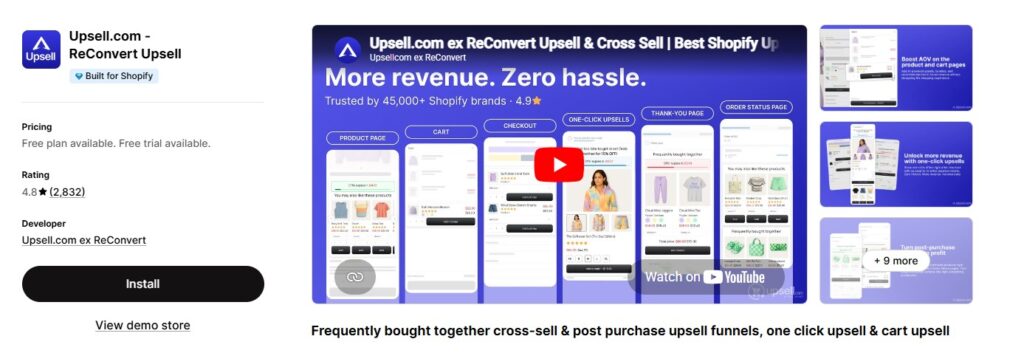
Rating: 4.8/5
Free Plan: Free plan available
Paid Plans: From $4.99/month
ReConvert is the top post-purchase upsell app on Shopify. It replaces the standard order confirmation page with a customizable thank-you page that includes one-click upsell offers, countdown timers, and product recommendations.
Key Features:
- One-click post-purchase upsell offers
- Customizable thank-you page builder
- Countdown timer for urgency
- Customer birthday collector
- A/B testing for upsell offers
Best for: Any Shopify store looking to increase revenue from customers who have just completed a purchase.
2. Frequently Bought Together
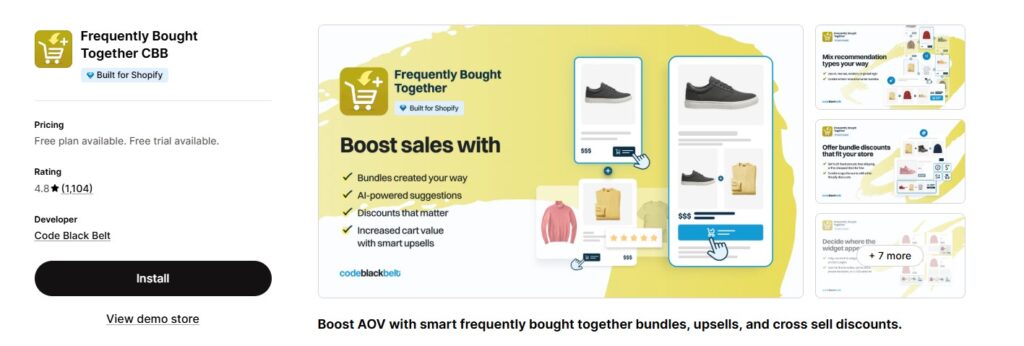
Rating: 4.8/5
Free Plan: Free plan available
Paid Plans: From $9.99/month
Frequently Bought Together uses AI to recommend product bundles on product pages, similar to the Amazon-style bundle feature. Customers can add multiple related products to their cart in one click.
Key Features:
- AI-powered product bundle recommendations
- One-click add all to cart
- Manual bundle creation option
- Discount rules for bundles
- Works with most Shopify themes
Best for: Stores with complementary products that naturally pair together, such as electronics, beauty, or fashion.
3. Checkout Plus Customizations
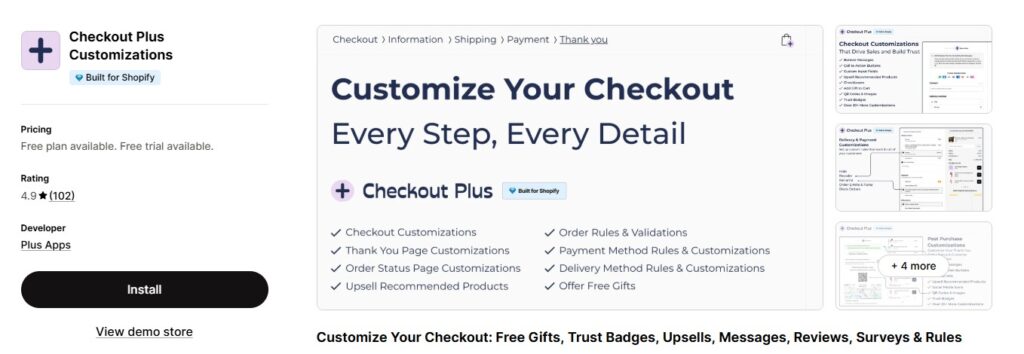
Rating: 4.9/5
Free Plan: Avaialble
Paid Plans: From $29/month
Checkout Plus lets Shopify merchants customize their checkout, thank you, and order status pages to create a more personalized shopping experience. It offers a range of no-code customization options, allowing stores to add helpful content, trust signals, and post-purchase features without modifying their theme.
Key Features:
- Checkout, Thank You, and Order Status page customization
- Custom content blocks, banners, and trust badges
- Upsell and cross-sell offers after checkout
- Custom fields, delivery instructions, and gift messages
- Conditional rules based on customer, cart, or order details
Best for: Shopify stores looking to personalize the checkout experience, improve customer engagement, and increase post-purchase revenue without coding.
Best Shopify Video Commerce Apps
Ever thought videos could be sold directly through your Shopify store? Well, it’s possible! With the right apps, you can easily sell and deliver video content directly to your customers through Shopify.
1. Videowise
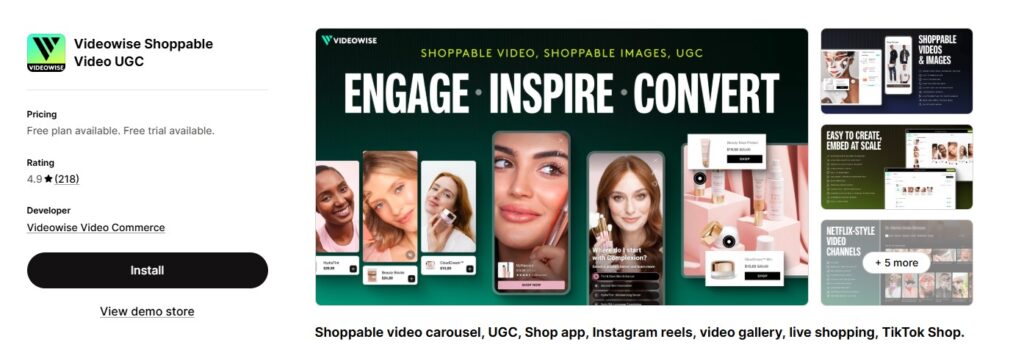
Rating: 4.9/5
Free Plan: Yes
Paid Plans: From $9/month
Videowise is a video commerce platform that makes video shoppable across your store. You can add shoppable videos, reels, and UGC to product pages, collections, and your homepage, and import the TikToks and Instagram videos you already have so shoppers can watch and add to cart without leaving the page. It also supports live shopping and AI video tools, with performance analytics that tie each video back to conversions.
Key Features:
- Shoppable video on product pages, collections, and homepage
- Import and make TikTok, Instagram, and UGC videos shoppable
- Video galleries, carousels, stories, and live shopping
- Product tagging so shoppers buy directly from the video
- Videos optimized to load without slowing your storefront
Best for: Stores that want to turn product and social video into on-site sales, especially fashion, beauty, and lifestyle brands.
How to Choose the Right Shopify Apps for Your Store
With over 17,600 apps available, it is easy to install too many and slow your store down. Here is a simple framework for choosing well:
- Start with one problem, not one category: Identify the biggest gap in your store first. If you are losing customers at checkout, start with an upsell or cart recovery app. If your products are not appearing in search, start with SEO.
- Check for Shopify compatibility: Look for apps with the Built for Shopify badge. These meet Shopify’s highest standards for performance, design, and security.
- Prioritize apps with a free plan: Free plans let you test before committing. FlexSync, for example, offers a free plan with up to 500 SKUs and full two-way Google Sheets sync. You can export your Shopify data into Google Sheets and start managing inventory without paying anything upfront.
- Watch your store speed: Each app adds code to your store. Install only what you need and check your Core Web Vitals score after adding new apps.
Frequently Asked Questions
What are the best free Shopify apps?
Several strong apps have free plans: FlexSync (inventory, up to 500 SKUs), DSers (dropshipping), Judge.me (reviews), Plug In SEO (SEO audits), and Klaviyo (email marketing, up to 500 contacts). These cover the most critical store functions at no upfront cost.
How many apps should a Shopify store have?
The average Shopify merchant installs around six apps (Uptek, 2026). There is no fixed number, but each app adds code that can affect page speed. Install only apps that solve a specific problem and remove any you are not actively using.
What is the best Shopify app for beginners?
For beginners, start with tools that are easy to set up and have free plans. FlexSync is a great starting point for inventory, as it works inside Google Sheets with no coding required. Read the complete guide to Shopify inventory management to understand how to manage stock properly from day one.
What is the best inventory management app for Shopify?
FlexSync is the top pick for stores that want to manage inventory from Google Sheets. It syncs two ways, supports bulk editing, handles multi-location inventory, and has a free plan for up to 500 SKUs. See the full best Shopify inventory management apps comparison for more options.
Do Shopify apps slow down your store?
Yes, poorly coded apps can add unnecessary scripts and slow your store’s load time. To minimize impact, use apps with the Built for Shopify badge, remove unused apps completely (not just disable them), and check your Core Web Vitals regularly using Google Search Console.
What is the best email marketing app for Shopify?
Klaviyo is the most widely used email marketing app on Shopify and the strongest option for stores serious about automation and segmentation. Omnisend is a great alternative for stores that want email, SMS, and push notifications in one tool at a lower price point.
What Shopify app is best for bulk editing products?
FlexSync is the best option for bulk editing. It lets you update product titles, prices, descriptions, SKUs, barcodes, and inventory counts directly from Google Sheets. Learn how to bulk edit product descriptions in Shopify using FlexSync.
Conclusion
The best Shopify apps depend on where your store is right now and what problem you need to solve first. Across every category covered here, the pattern is the same: start with a tool that has a free plan, test it properly, then scale up.
For inventory management, FlexSync stands out as the best starting point. It connects Shopify to Google Sheets, handles bulk editing and multi-location stock, and offers a free plan that works for most small stores. You can also manage your Shopify inventory policy directly from your spreadsheet.
Pick one app per problem, keep your stack lean, and upgrade only when your store outgrows the free tier.
