A Shopify mobile app used to mean hiring an agency and waiting months. Today a mobile app builder connects to your store, pulls in your catalog, and produces iOS and Android apps you publish yourself.
The catch is that mobile app builder apps for Shopify differ in ways the listings don’t make obvious. Some run on your existing theme, while others use a separate editor you maintain by hand. Some charge a flat monthly fee, and others add a percentage once your app revenue passes a threshold. Free plans often stop short of publishing to the app stores.
This guide compares five best mobile app builder apps for Shopify on what they do, what they cost and who they suit, using the live App Store listings. A bonus pick for inventory sits at the end.
Table of Contents
Quick Comparison: Mobile App Builder Apps for Shopify
| # | App | Rating | Starting Price | Free Trial | Success Fees | Built for Shopify |
| 1 | Apploy: Mobile App Builder | 5.0 (19 reviews) | $49/mo | 7 days (Micro), 14 days on higher tiers | None | Yes |
| 2 | Shopney: Mobile App Builder | 5.0 (770 reviews) | $149/mo | 30 days | None listed | Not shown |
| 3 | OneMobile: Mobile App Builder | 4.8 (365 reviews) | Free plan; paid from $99/mo | 14 days | 2.9% above $2,000 mobile revenue on Scale•Up | Yes |
| 4 | Ego Mobile App Builder | 5.0 (73 reviews) | Free plan; paid from $79/mo | 14 days | None | Yes |
| 5 | SimiCart: Mobile App Builder | 4.5 (39 reviews) | Free plan; paid from $99/mo | 14 days | None | Yes |
Ratings and pricing come from the Shopify App Store listings at the time of writing. Check the current listing before installing.
1. Apploy: Mobile App Builder
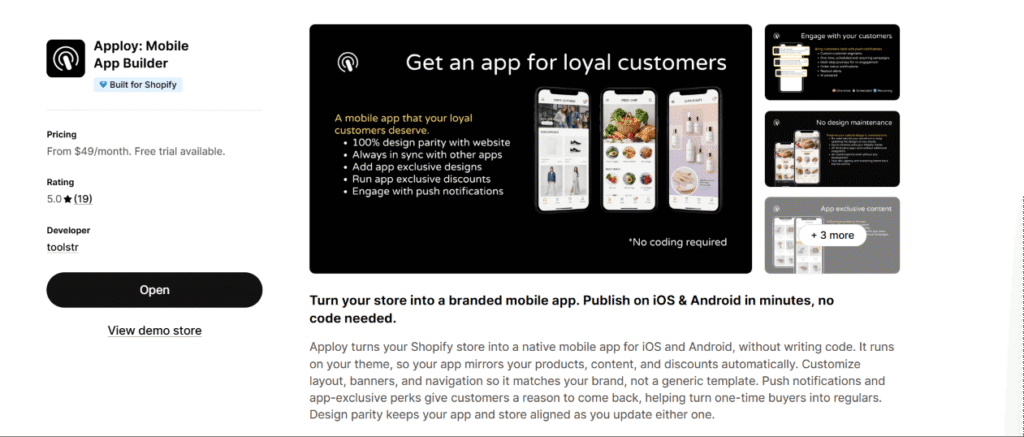
Best for stores that update their storefront often and don’t want a second thing to maintain.
Apploy builds a native iOS and Android app that runs on your existing Shopify theme. Products, content, discounts and theme changes sync automatically, so there is no separate app editor to keep current. Change a collection on the website and it changes in the app. Our guide to how real-time sync works explains the mechanics.
That matters most for stores running drops, seasonal campaigns or frequent merchandising, where maintaining two layouts would mean doing every update twice. It also has the lowest paid entry point on this list, with a Micro tier built for stores under three months old.
Key Features
- Runs on your existing Shopify theme, with sync for products, content and discounts
- No-code design tools, with publishing to the Apple App Store and Google Play
- Push notifications, unlimited from Starter up
- Abandoned cart and abandoned search recovery (Growth and above)
- App-exclusive content, discounts and multi-step journeys (Plus)
- App analytics listed on the Micro and Starter tiers
Pricing
- Micro: $49/month (stores under three months old, 7-day free trial)
- Starter: $99/month (unlimited push notifications, 14-day free trial)
- Growth: $199/month (abandoned cart and search recovery, white-glove onboarding)
- Plus: $499/month (multi-step journeys, app-exclusive content and discounts, concierge support)
No success fees and no per-message charges at any tier.
Best for: Stores with a changing catalog and repeat customers. The review count is small (18), so the 5.0 score has less evidence behind it than the larger listings below. For a cost breakdown across builders, see their Shopify app builder pricing guide.
👉 Read our guide on Best order management apps & overall Best apps for shopify
2. Shopney: Mobile App Builder
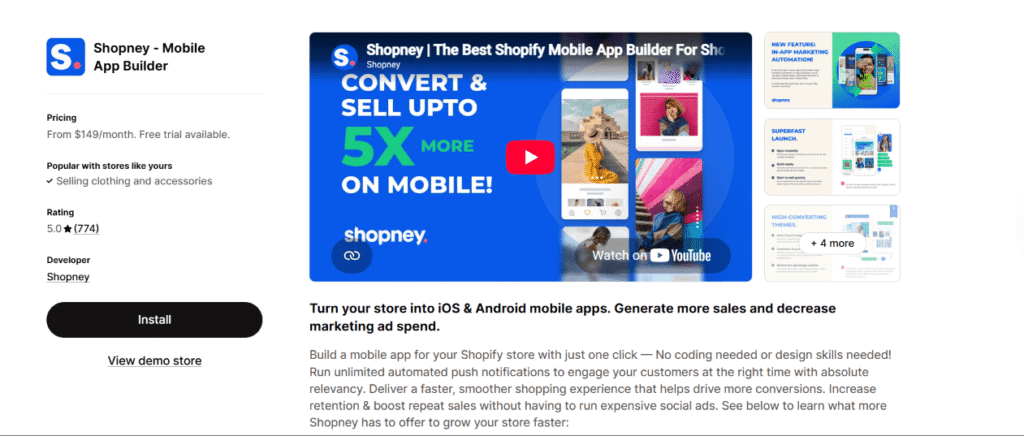
Best for established stores that want deep marketing integrations and a long trial.
Shopney turns a Shopify store into iOS and Android apps and has the most reviews on this list, at 5.0 from 770. Every plan carries a 30-day free trial, the longest here, and the listing names no success fee. Higher tiers connect to tools such as Klaviyo, Rebuy and Nosto, and add segmented and AI push notifications.
The tradeoff is price. There is no free tier and the entry plan is $149/month, so it is aimed at stores that already have sales to build on.
Key Features
- Unlimited push notifications from the entry plan
- Back-in-stock and abandoned cart notifications
- In-app chat and campaigns
- Segmented and AI push, AR and barcode scanning on higher tiers
- Integrations with Klaviyo, Smile, Yotpo, Judge.me and others
Pricing
- Silver: $149/month
- Gold: $299/month
- Platinum: $599/month
- Enterprise: $1,299/month
All plans include a 30-day free trial.
Best for: Mid-size and larger stores with a marketing stack already in place.
Save time and drive more sales with FlexSync
Install FlexSync →3. OneMobile: Mobile App Builder
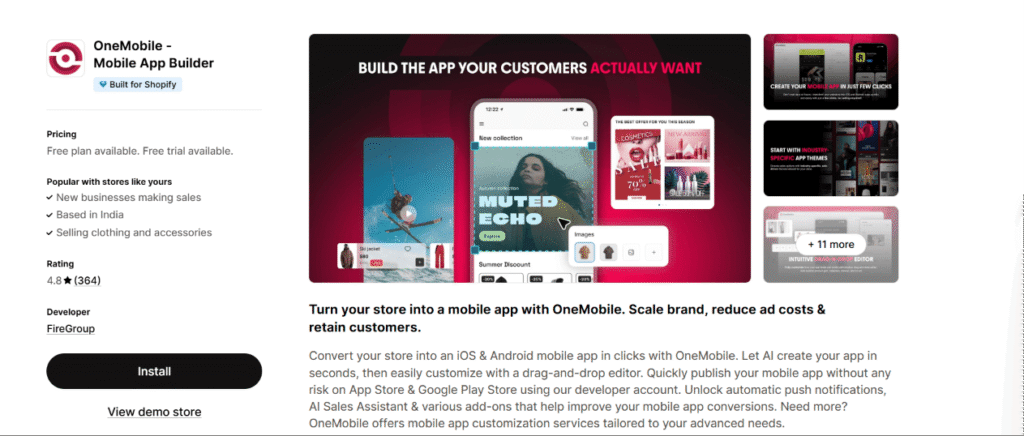
Best for merchants who want a free plan to test with and an AI-assisted design flow.
OneMobile carries the Built for Shopify badge and 4.8 stars from 365 reviews. It offers a free plan, an AI-generated app design with a drag-and-drop editor, and publishing through OneMobile’s own developer account. Native iOS and Android apps start from the Scale•Up tier.
Read the fee structure before choosing it. Each paid tier adds an infrastructure fee on mobile revenue above a threshold, so cost grows with your app’s success. One long-term reviewer also complained that a pricing change raised their bill.
Key Features
- AI-generated app design with a drag-and-drop editor
- Native iOS and Android apps (Scale•Up and above)
- Segmented, automated and AI-personalized push notifications
- Wishlist, deep linking and video shopping on higher tiers
- Integrations with Klaviyo, Google Analytics and Tidio
Pricing
- Free: $0
- Scale•Up: $99/month, 14-day trial, 2.9% fee on mobile revenue above $2,000
- Brand•Up: $299/month, 14-day trial, 1.9% fee above $10,000
- Omni: $990/month, 1.2% fee above $100,000
Best for: Stores that want to start free and accept a revenue-linked fee as they grow.
4. Ego Mobile App Builder
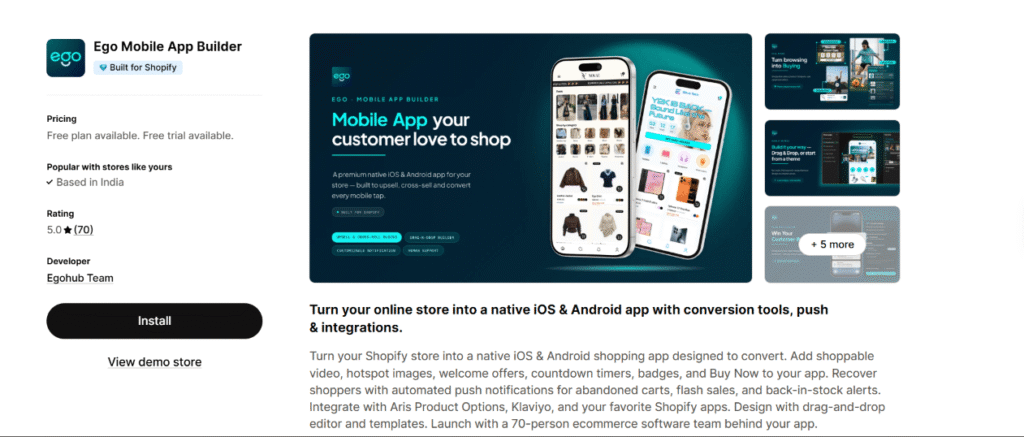
Best for stores that want conversion features, such as shoppable video and countdown timers, in the app.
Ego is native for iOS and Android, rated 5.0 from 73 reviews, and carries the Built for Shopify badge. The free plan gives you a basic editor with two templates, 12 screens and a built-in wishlist, but publishing to the app stores starts on the $79 Growth plan.
Growth and Scale state “No Hidden Fees” and “No Revenue-share Fee,” which makes cost easy to forecast.
Key Features
- Drag-and-drop editor with templates and live preview
- Shoppable video, hotspot images, welcome offers and countdown timers
- Automated push for abandoned carts, flash sales and back-in-stock alerts
- Built-in wishlist and live chat support
- Judge.me and Klaviyo integrations
Pricing
- Free: $0 (basic editor, no store publishing)
- Growth: $79/month, 14-day trial
- Scale: $199/month, 14-day trial
- Enterprise: $499/month, 14-day trial
Best for: Stores that want to test the editor before paying and then publish at a moderate price.
5. SimiCart: Mobile App Builder
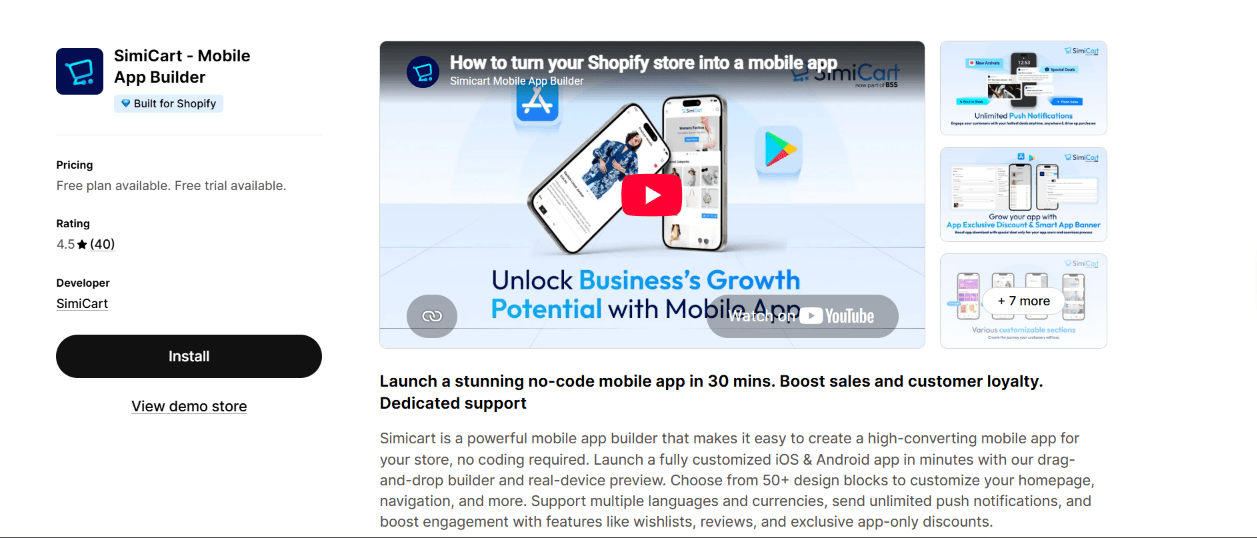
Best for stores that want a fixed fee and dedicated support.
SimiCart promises a no-code app in about 30 minutes and describes the result as native. It carries the Built for Shopify badge with 4.5 stars from 39 reviews. The Basic plan includes iOS and Android publishing, unlimited push, wishlists and product reviews, and every paid tier states “no success fee.”
The Pro plan adds app-exclusive discounts and loyalty integration, and Premium adds a dedicated success manager.
Key Features
- Drag-and-drop builder with real-device preview
- 50+ design blocks and ready-made themes
- Unlimited push notifications and a smart app banner
- Wishlists, product reviews and custom product labels
- Klaviyo, Omnisend and Judge.me integrations
Pricing
- Free: $0 (20 homepage blocks, real-device preview)
- Basic: $99/month, 14-day trial
- Pro: $149/month, 14-day trial
- Premium: $249/month, 14-day trial
Best for: Stores that want predictable monthly pricing across all paid tiers. It has the lowest rating and fewest reviews here, so read recent feedback.
Which Mobile App Builder Is Best for What?
Match the builder to your situation:
- Frequent storefront changes and no appetite for a second editor: Apploy, because it runs on your existing theme.
- A larger store with a full marketing stack: Shopney, with a 30-day trial.
- Starting on a free plan: OneMobile, Ego or SimiCart, with the fee and publishing limits noted above.
- Conversion features inside the app: Ego.
- Predictable pricing with dedicated support: SimiCart.
Bonus: Keeping Stock Accurate With FlexSync
An app that pushes shoppers to products only works if the stock behind them is right. FlexSync isn’t a mobile app builder. It syncs inventory between Shopify and Google Sheets in both directions, in real time, so you can bulk-edit products, prices and variants from a spreadsheet and get low-stock alerts there.
It has a free plan for up to 500 SKUs, with paid plans from $9/month to $49/month and a 14-day trial on each paid tier. It is rated 4.8 from 22 reviews and has the Built for Shopify badge. It suits catalogs where editing one product at a time has become the bottleneck.
Frequently Asked Questions
Q1. What are the best mobile app builder apps for Shopify?
Five widely used options are Apploy, Shopney, OneMobile, Ego and SimiCart. Apploy suits stores wanting automatic sync with their theme, Shopney suits larger stores, and the other three offer free plans with limits. The best choice depends on budget, catalog size and how often you change your storefront.
Q2. How much does a Shopify mobile app builder cost
Paid plans on this list start between $49 and $149 per month, and three builders offer free plans. Watch for fees beyond the monthly price: OneMobile charges a percentage of mobile revenue above a threshold, while Apploy, Ego and SimiCart state no success fees.
Q3. Do I need to code to build a Shopify mobile app?
No. All five builders are no-code and connect to your existing store. Check whose developer accounts the app publishes under; OneMobile’s listing says it uses its own.
Q4. Can these builders publish to the App Store and Google Play?
Most do on their paid plans. Ego’s free plan, for example, doesn’t publish, and publishing starts on its Growth plan. Confirm publishing and account ownership on the listing before you install.
Q5. Is a native app better than a hybrid app?
Not automatically. Native apps are built for each platform, while hybrid apps share code. What matters for a store is how the app performs, how it stays in sync with your catalog, and what it costs. Most builders here describe their output as native.
Q6. Can I switch mobile app builders later?
Yes, but plan for it. Your products live in Shopify, but app design, push subscribers and published listings may not transfer. Ask any builder what you keep before you commit.
Final Thoughts
The right choice among mobile app builder apps for Shopify depends on how your store works. If you change your storefront often and want the app to follow automatically, Apploy is built for that. If you’d rather start free, test OneMobile, Ego or SimiCart. And if you have a large marketing stack, look at Shopney
