If you have landed on this page, chances are your Shopify store has reached the point where managing warranties manually just does not work anymore. Maybe support tickets are piling up with customers asking whether their product is still covered. Maybe your team is spending hours cross-referencing spreadsheets with Shopify orders just to verify a single claim. Or maybe a duplicate claim slipped through last week because nobody had a clear view of what had already been filed.
Most Shopify brands hit this wall eventually. Order volume grows, and the patchwork of email threads, shared Google Sheets, and sticky-note reminders that worked at 50 orders per month collapses at 500. Customers who need help end up waiting days for a response. Claims get lost. Registration data sits scattered across tools that do not talk to each other.
Shopify warranty apps exist to fix exactly this. The right one automates product registration, claims processing, eligibility checks, and customer communication so your team stops firefighting and starts running warranty operations from a single dashboard. This guide breaks down the 7 best Shopify apps for warranty management automation in 2026, covering what each one does well, where it falls short, and how to match the right tool to your store’s specific needs.
Table of Contents
What Is Warranty Management Automation?
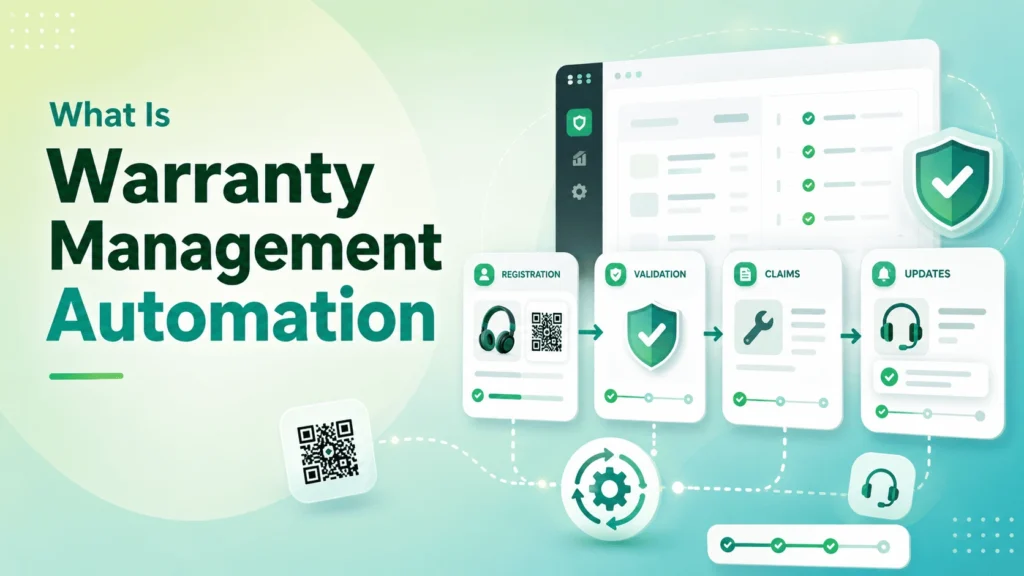
Warranty management automation is basically replacing manual warranty tasks with software that handles product registration, claims intake, eligibility validation, status tracking, and customer communication automatically.
Without automation, warranty management on Shopify typically looks like this: a customer emails your support inbox saying their product is defective. Your team searches Shopify orders to confirm the purchase date. Someone manually checks whether the product is still within the warranty window. If it is, another team member creates a ticket in a separate tool, emails the customer for photos or proof of purchase, and then follows up days later with a resolution.
Every step in that process is a place where things break. Emails get lost. Spreadsheets fall out of date. Customers get frustrated waiting. Duplicate claims slip through because nobody has a single view of what has already been filed.
Warranty management automation replaces all of that with structured workflows. A customer registers their product through a branded form or QR code scan, and the system creates a verified ownership record. When they file a claim, the software checks eligibility automatically, creates a ticket, assigns it to the right team member, and sends the customer real-time updates. Your team works from one dashboard instead of five tabs.
For Shopify merchants specifically, this matters because order data already lives in your store. A good Shopify warranty app syncs directly with your product catalog and order history, which means less manual data entry and faster claim validation.
Why Your Shopify Store Needs a Warranty Management App
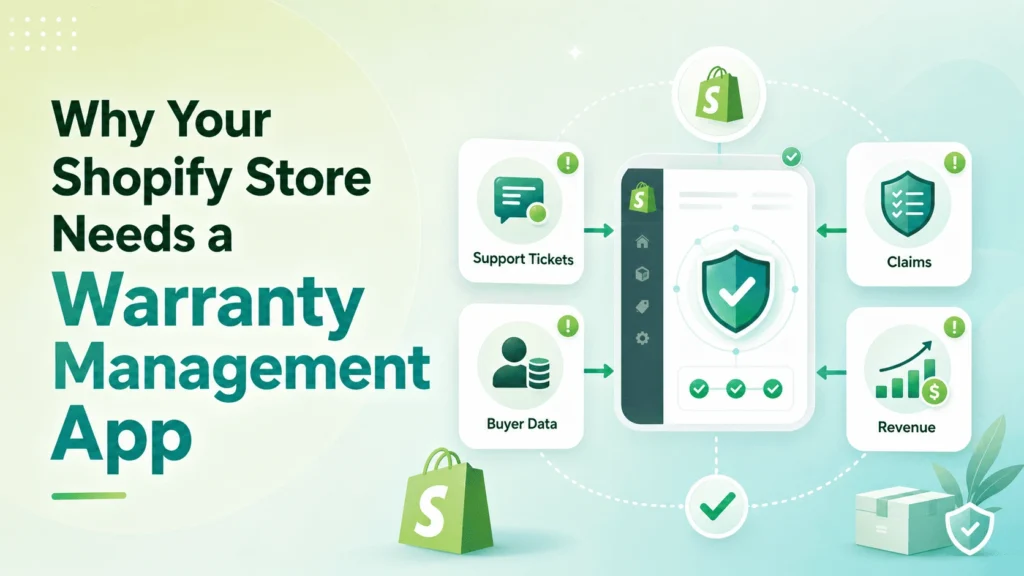
If your current warranty process involves email threads and spreadsheet tracking, you are already losing time, money, and customers. Here is what actually happens when brands try to manage warranties manually at scale.
Support tickets eat up your team’s day. Every warranty inquiry requires your team to look up the order, verify the product, check the warranty period, and then respond. That is 10 to 15 minutes per ticket. At 50 warranty requests per month, you are burning over 12 hours just on verification, before anyone even starts resolving the issue.
You have no first-party data from offline and marketplace buyers. If your brand sells through Amazon, retail stores, or distributors, Shopify order data only captures a fraction of your actual customers. The buyer who picked up your product at a retail store never shows up in your Shopify dashboard. Without a warranty registration system, you have no way to identify them, contact them, or build a relationship with them.
Missed upsell opportunities cost you revenue. The moment a customer registers a product or files a claim is a high-intent touchpoint. They are actively engaged with your brand. Without the right system, that moment passes with a generic email confirmation and nothing else. No extended warranty offer. No accessory recommendation. No cross-sell. That is revenue left on the table.
Slow claim resolution drives customers away. Research from PwC shows that customers are more inclined to buy from brands that deliver a superior post-sales experience. When a customer files a warranty claim and waits three days for a response, that is not a superior experience. Automation closes that gap by validating claims instantly and keeping customers informed at every step.
What to Look for in a Shopify Warranty App
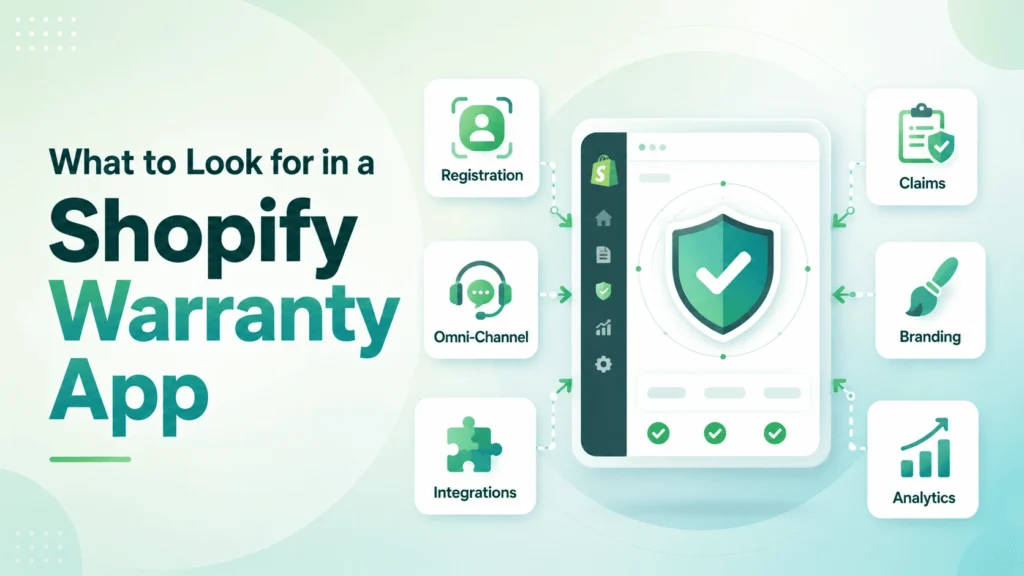
Not all warranty apps solve the same problems. Some focus on registration, some on claims, some on selling extended warranties, and a few try to cover the full lifecycle. Before choosing, know what actually matters for your store.
Automated Warranty Registration and Activation:
The foundation of warranty management is knowing who owns your product and when their coverage started. A strong Shopify warranty app should let customers register products with minimal friction, either through an embedded widget on your store or a QR code on the product packaging. The registration should automatically activate the warranty, issue a digital warranty card, and capture verified customer data. If your app requires manual activation by your team, that defeats the purpose.
Claims Workflow and Ticket Management
Filing a claim should not mean sending an email into the void. Look for apps that offer structured claim submission with required fields (photos, proof of purchase, issue description), automatic eligibility checks based on warranty rules, and ticket assignment to specific team members. Real-time status updates to the customer via email or SMS are also critical. The goal is that your team processes claims from a single dashboard, not a combination of email, Slack, and spreadsheets.
Omni-Channel Coverage (Online, Retail, Marketplace)
This is where most warranty apps fall short. If you only sell through Shopify checkout, basic registration tools work fine. But if any portion of your sales happens through Amazon, retail partners, offline events, or distributors, you need a way to capture those buyers too. QR codes on packaging, standalone registration pages, and multi-channel data capture are the features that close this gap. Without them, a significant chunk of your customer base remains invisible.
Customization and Branding Control
Your warranty experience should look like your brand, not a generic third-party form. Customizable registration pages, branded email templates, and white-label customer portals all matter. When a customer registers a product or checks their claim status, the experience should feel seamless with the rest of your store.
Integrations With Your Existing Tech Stack
Warranty data is only useful if it flows into the tools your team already uses. Check whether the app integrates with your helpdesk (Gorgias, Zendesk), CRM (HubSpot), email marketing platform (Klaviyo, Mailchimp), or other systems. Without integrations, warranty data stays siloed and your team ends up doing double entry.
Analytics and Warranty Data Insights
Warranty data tells you more than just who filed a claim. It reveals which products fail most often, which channels generate the most claims, how fast your team resolves issues, and where fraud patterns emerge. A good warranty app surfaces these insights in a dashboard so you can act on them, not just track them.
Best Shopify Apps to Automate Warranty Management in 2026
Before diving into individual reviews, here is a quick comparison to help you see the landscape at a glance.
| App | Best For | Registration | Claims Management | Omni-Channel | Extended Warranty Sales | Starting Price |
| Dyrect | End-to-end warranty automation for omni-channel brands | Yes | Yes | Yes (QR + embed) | Yes | Free plan available |
| Propel Warranty Registration | Affordable registration and claims for small stores | Yes | Basic | No | No | Free plan available |
| My Product Registration | Mature registration with deep form customization | Yes | Yes | Limited | No | $15/month |
| Webkul Warranty Management | Displaying and selling extended warranties on product pages | No | No | No | Yes | $9/month |
| AfterShip Returns & Exchanges | Returns and exchange automation at scale | No | Returns only | No | No | Free plan available |
| SeriaLogic | Serial number assignment and tracking | No | No | No | No | Free trial available |
| Warranly | Self-managed extended warranty upsells with zero commissions | No | No | No | Yes | Free |
👉 Learn more about the Essential Apps for Manging a Shopify Store →
1. Dyrect: End-to-End Warranty Registration and Claims Management
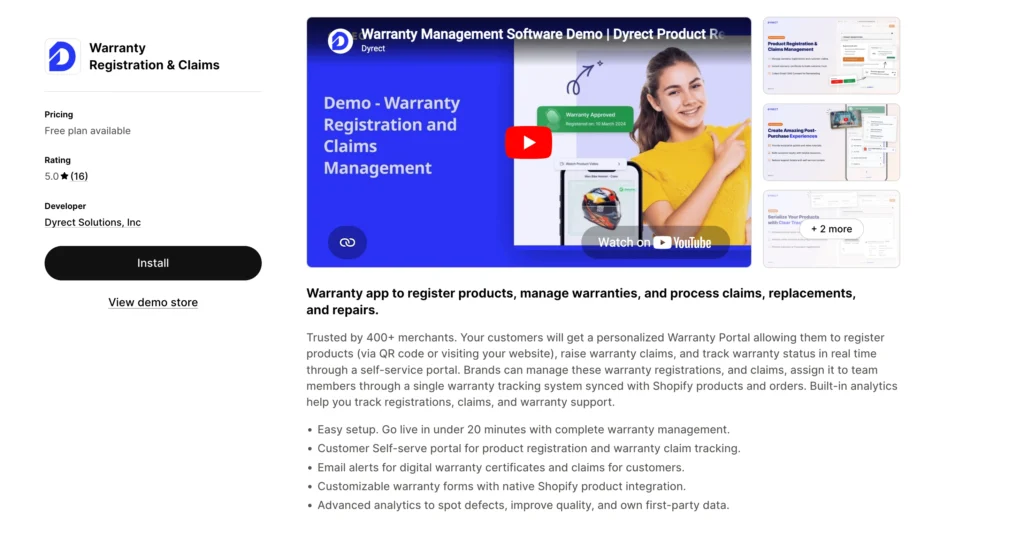
Dyrect is the most complete Shopify warranty app on this list. It covers the full warranty lifecycle, from the moment a customer registers a product to the final resolution of a claim, all within a single platform that syncs natively with your Shopify store. Where most warranty apps handle one piece of the puzzle, Dyrect connects product registration, claims management, customer communication, analytics, and post-purchase revenue in one system.
What sets Dyrect apart is how it approaches warranty management not just as a support function, but as a growth channel. The platform captures verified first-party data at registration, gives customers a self-service portal for tracking warranties and submitting claims, and creates opportunities to upsell extended warranties, accessories, and protection plans at the moment of highest customer engagement.
Dyrect is trusted by 350+ merchants and serves global brands across electronics, home products, appliances, outdoor gear, and wellness devices. Setup takes under 20 minutes.
Omni-Channel Product Registration That Captures Every Buyer
Over 50% of consumer brand sales happen through offline retail stores, marketplaces like Amazon, or distributor channels. Shopify order data does not capture those buyers. Dyrect solves this with omni-channel registration that works through QR codes on product packaging (for offline and marketplace buyers) and embedded widgets on your Shopify store (for online buyers).
When a customer scans the QR code or fills out the embedded form, they register their product, activate the warranty, and become a verified contact in your system. The brand collects their email, phone number, sales channel, and location. Physical warranty cards are replaced entirely with digital warranty certificates sent via email or SMS.
Dyrect’s no-code form builder lets you customize every aspect of the registration experience. Multi-part forms reduce abandonment. Built-in email and phone verification ensures the data is real. AI-powered serial number validation blocks duplicate registrations and confirms product authenticity.
The result: every customer from every channel, online or offline, ends up in one system. Brands using Dyrect have seen a 30% improvement in registration rates and a 110% increase in customer engagement from retail customers.
Automated Claims Processing With Real-Time Customer Updates
Once a product is registered, handling claims becomes significantly easier. Dyrect’s claims management system validates claim eligibility automatically based on warranty rules, serial number records, and proof of purchase. Each claim generates a ticket that can be assigned to specific team members, tracked through resolution, and closed with full audit trail.
Customers receive real-time updates via email, SMS, or WhatsApp at every stage of the claim. They never need to call or email asking for a status update. Your support team works from a single dashboard where they can see all open claims, their status, assigned agent, and resolution history.
For brands managing repair and replacement workflows, Dyrect supports item-level tracking through the entire service process. Dealer chargeback processing is built in for brands working with channel partners. According to Dyrect data, brands using the platform experience 50% faster claims processing.
Best suited for: Growing omni-channel Shopify brands in electronics, home products, appliances, outdoor gear, and wellness that want complete warranty automation with data capture and revenue generation.
Key Features
- Omni-channel product registration via QR codes and Shopify-embedded widgets
- Automated claims processing with eligibility validation and ticket assignment
- Self-service customer portal for registration, claims, and warranty status tracking
- Digital warranty cards replacing physical paper cards
- AI-powered serial number validation and fraud prevention
- No-code drag-and-drop form builder with multi-part forms
- Real-time customer notifications via email, SMS, and WhatsApp
- Repair, replacement, and dealer chargeback workflows
- Extended warranty and accessory upsell at registration
- Native integrations with Gorgias, Zendesk, HubSpot, Klaviyo, Mailchimp, Zoho Desk
- Advanced analytics for product defects, claim trends, and registration performance
Pros
- Covers the entire warranty lifecycle in one app, from registration to claims to upsell
- Omni-channel registration captures customers that no other Shopify warranty app reaches
- Deep analytics turn warranty data into actionable product and customer insights
- 5.0 Shopify App Store rating and 4.8 G2 rating show consistent user satisfaction
- Setup in under 20 minutes with native Shopify product and order sync
Cons
- The breadth of features may be more than very small stores need if they only want basic registration
- Advanced claims and repair workflows require the higher-tier plan
Pricing: Free plan available. Registration-focused plan at $19/month. Registration + claims at $49/month. Advanced plan with repair, replacement, billing, and service visibility at $149/month.
2. Propel Warranty Registration: Lightweight Registration and Claims for Small Stores
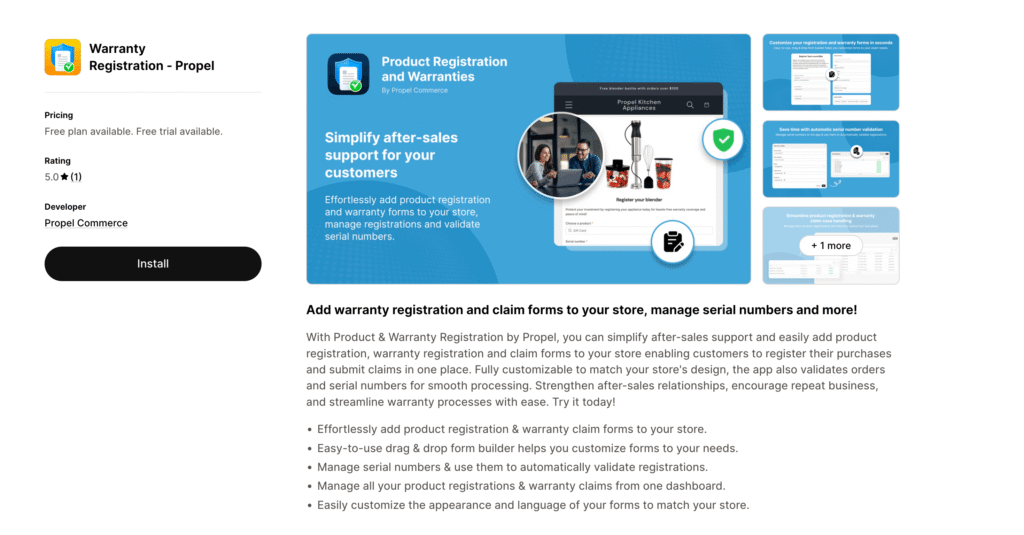
Propel is a clean, affordable warranty registration app built for Shopify stores that want to move away from email-based warranty requests without investing in a full-scale platform. If your brand is in its early stages and needs a straightforward way to collect product registrations and warranty claims, Propel delivers that without complexity.
The app lets you create branded registration and claim forms using a drag-and-drop builder. Customers can register products through a product page block, a standalone landing page, or a link in a post-purchase email. Serial number validation is included, which helps prevent incorrect or duplicate registrations.
Propel works well for stores selling gadgets, accessories, small appliances, tools, and hobby products where the warranty process is relatively simple: customer registers, customer files a claim if needed, and your team reviews and resolves it from the app dashboard.
Where Propel falls short is in depth. There is no customer self-service portal, no omni-channel registration (no QR codes for offline buyers), no analytics beyond basic tracking, and no integrations with helpdesk or CRM tools. For a small store processing a modest number of warranty requests per month, that is perfectly fine. For a brand with multiple sales channels or growing claim volume, those gaps become noticeable quickly.
Best suited for: Small Shopify stores that want affordable, easy-to-setup warranty registration and claims collection without heavy infrastructure.
Key Features
- Drag-and-drop form builder with branded fonts and colors
- Product registration and warranty claim submission in one dashboard
- Serial number validation at registration
- Multiple registration touchpoints: product page, landing page, or email link
- Order validation to match registrations with Shopify orders
Pros
- Very affordable with a free plan and a $9.95/month Pro tier
- Simple setup that does not require technical expertise
- Clean interface that is easy for small teams to manage
- Built for Shopify badge confirms native integration quality
Cons
- No omni-channel registration (no QR codes for offline or retail buyers)
- No customer self-service portal for warranty or claim status tracking
- No CRM, helpdesk, or email marketing integrations
- Limited analytics and reporting
- Very small review base, making it harder to evaluate long-term reliability
Pricing: Free plan available. Pro plan at $9.95/month includes unlimited registrations, serial validation, warranty claims, and priority support.
3. My Product Registration: Mature Registration With Deep Form Customization
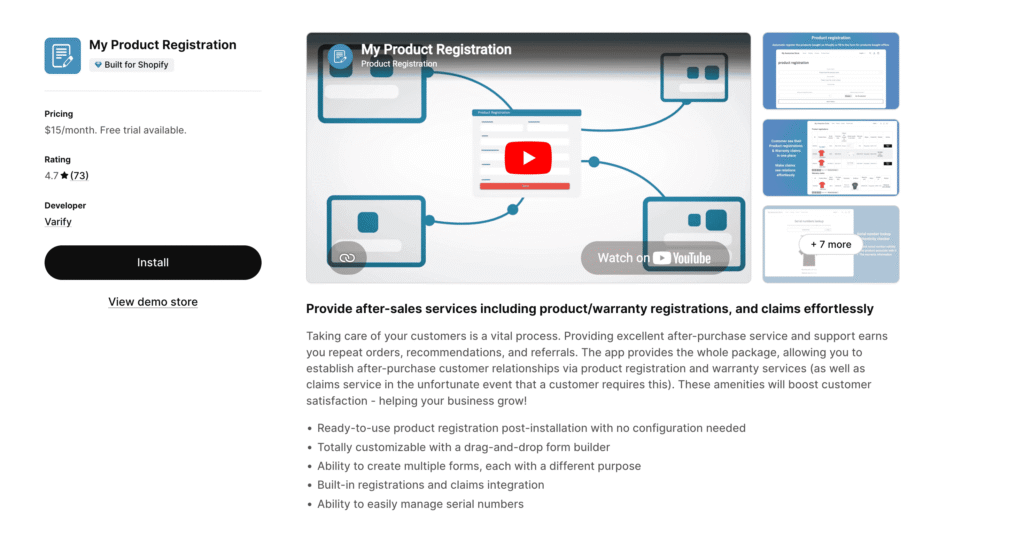
My Product Registration by Varify is one of the more established apps in the Shopify warranty and product registration category. It has been around long enough to accumulate a solid review base, and merchants consistently praise its form customization depth and responsive support team.
The app is ready to use immediately after installation with zero configuration needed. You can create multiple registration forms, each with a different purpose, using a drag-and-drop builder. Conditional logic lets you show or hide fields based on customer inputs. Serial number control lists, status management, warranty claims, marketing automation triggers, and custom CSS/JS are all available.
Multi-language support makes it a strong choice for international Shopify stores. Old registration entries can be imported, so you do not lose historical data when switching from another system.
Where My Product Registration works best is in the registration and basic claims workflow. It handles the core job well: customers register, you track registrations, and if a claim comes in, you manage it through the app. The support team is frequently mentioned in reviews as exceptionally fast and willing to build custom solutions.
The limitations show up when you need more than registration and claims. There is no omni-channel registration through QR codes, no advanced analytics dashboard, no self-service customer portal with real-time claim tracking, and no native integrations with helpdesk or CRM platforms at the depth you would find in a more comprehensive solution.
Best suited for: Established Shopify merchants who need a dependable, mature product registration and warranty claims app with strong form customization at a flat monthly price.
Key Features
- Ready-to-use product registration immediately post-installation
- Drag-and-drop form builder with conditional logic
- Multiple forms for different purposes (registration, claims, feedback)
- Serial number control and validation
- Warranty claims management with status tracking
- Multi-language support for international stores
- Marketing automation triggers
- Custom CSS and JavaScript support
- Historical data import
Pros
- One of the most established warranty registration apps on Shopify with a strong review history
- Deep form customization including conditional logic and multi-part forms
- Excellent customer support with fast response times
- Built for Shopify badge confirms integration quality
- Flat monthly pricing with no per-registration fees
Cons
- No omni-channel registration via QR codes for offline or marketplace buyers
- No dedicated self-service customer portal
- No native integrations with Gorgias, Zendesk, HubSpot, or Klaviyo
- Limited analytics compared to full warranty management platforms
- No extended warranty upsell or revenue generation features
Pricing: From $15/month. Free trial available.
👉 Learn more about the Top Shopify Inventory Management Apps →
4. Webkul Warranty Management: Extended Warranty Display and Sales on Product Pages
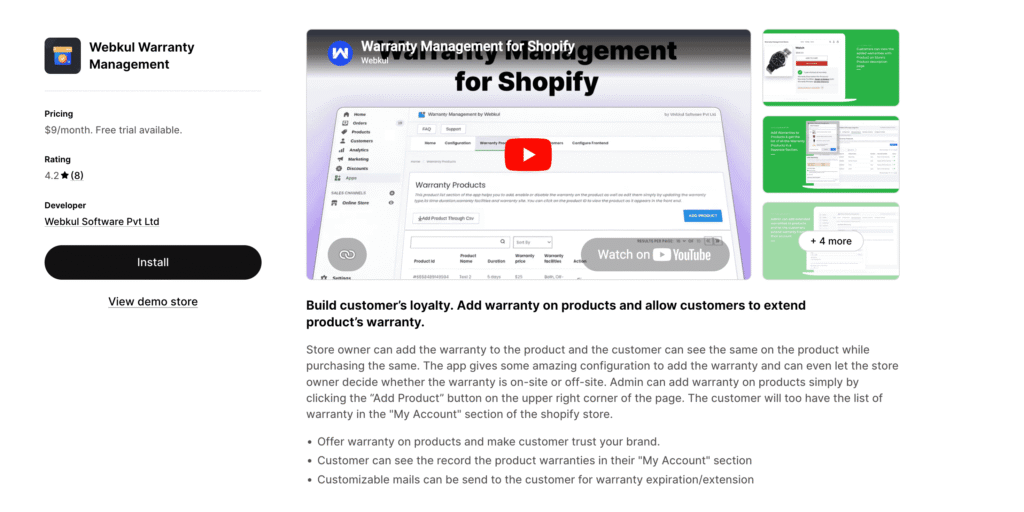
Webkul Warranty Management takes a different approach than the other apps on this list. Instead of focusing on product registration and claims, Webkul is built for displaying and selling warranty plans directly on your Shopify product pages.
With Webkul, you add default and extended warranties to individual products. Customers see the warranty options while browsing, can choose to extend their coverage at purchase, and view their warranty records in the “My Account” section of your store. The app supports both on-site and off-site warranty types, sends customizable expiration and renewal reminder emails, and allows customers to purchase extended warranties even after their original order.
The setup involves adding products one by one (or via CSV bulk upload) and configuring warranty duration, facilities, and pricing for each. Webkul also supports product parts warranty, where individual components of a product can have separate warranty coverage.
Where Webkul fits well is if your primary goal is to sell extended warranty plans as a revenue stream on your product pages. It is essentially a warranty upsell and display tool. Brands selling electronics, appliances, and high-value items can use it to present protection plans at checkout and generate additional revenue.
Where it does not fit is in managing the warranty lifecycle. There is no product registration workflow for capturing customer data from offline or online buyers. There is no structured claims management system. There is no customer self-service portal. And analytics are limited. If a customer actually needs to file a warranty claim, you are back to managing it through email or a separate tool.
Best suited for: Shopify stores that want to display and sell extended warranty plans on product pages as an additional revenue stream, without needing full warranty lifecycle management.
Key Features
- Add default and extended warranties to Shopify products
- Warranty options visible on product pages during purchase
- On-site and off-site warranty type configuration
- Warranty expiration and renewal reminder emails
- Post-purchase extended warranty purchase option
- Customers view warranty records in “My Account”
- CSV bulk upload for warranty products
- Product parts warranty support
Pros
- Focused solution for selling extended warranties directly on product pages
- Affordable entry point at $9/month
- Good onboarding support with video call assistance
- Supports multiple markets and warranty types
Cons
- No product registration or customer data capture workflow
- No claims management or ticketing system
- No customer self-service portal for claim tracking
- Limited integrations with third-party tools
- Smaller review base with a 4.2 rating, and one review flagging issues with product variant conflicts
- Managing actual warranty claims requires a separate tool or manual process
Pricing: Basic plan at $9/month or $99/year. Free trial available.
5. AfterShip Returns & Exchanges: Returns Automation With Warranty-Adjacent Features
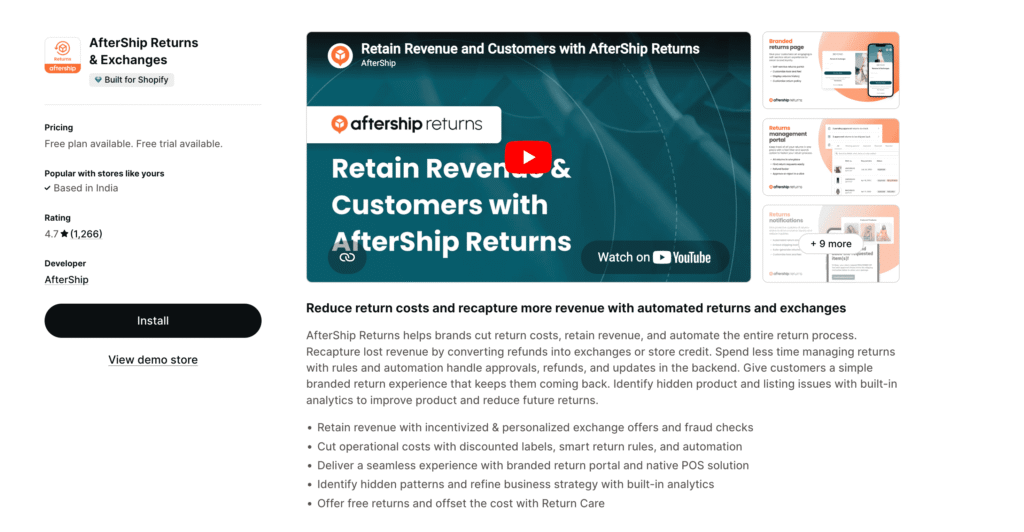
AfterShip Returns & Exchanges is one of the most widely used returns management apps on Shopify, with over a thousand reviews and a 4.7 rating. It is a mature, feature-rich platform built to help brands cut return costs, retain revenue through exchanges and store credit, and automate the entire returns process.
The app provides a branded self-service returns portal where customers initiate returns, select their preferred resolution (refund, exchange, or store credit), and generate shipping labels. Automated workflows handle approvals, route returns to the right location, and update customers at every step. AfterShip integrates with 68 carriers worldwide for label generation and supports advanced features like returns fraud detection, bundle returns, and green returns.
For brands with high return volumes, AfterShip delivers real value. The exchange-first approach, where the platform incentivizes customers to exchange rather than refund, helps retain revenue. Analytics show you which products get returned most and why, so you can fix listing issues or product problems.
However, AfterShip is fundamentally a returns and exchanges platform, not a warranty management tool. It does not handle product registration, warranty activation, digital warranty cards, serial number validation, or structured warranty claims processing. Warranty handling is available only at the Enterprise tier with custom pricing. If your primary need is managing the warranty lifecycle, AfterShip will handle the returns piece but leave significant gaps in registration, claims, and customer data capture.
AfterShip makes this list because many Shopify brands search for warranty solutions and find returns apps instead. If your “warranty problem” is actually a “returns and exchanges problem,” AfterShip is excellent. If you need actual Shopify warranty management with registration, claims, and customer data collection, you will need a dedicated warranty app alongside or instead of AfterShip.
Best suited for: Shopify stores with significant return volumes that want to automate returns, convert refunds into exchanges, and retain revenue. Not a replacement for warranty registration and claims management.
Key Features
- Branded self-service returns portal
- Exchange-first workflows that convert refunds into exchanges or store credit
- Automated return label generation with 68 carriers
- Returns fraud detection and prevention
- RMA management with tags, comments, and shipment tracking
- Returns analytics with product-level insights
- Green returns (no return shipment required for low-value items)
- Bundle returns with prorated refunds
- In-store returns via Happy Returns integration (9,000+ locations in the U.S.)
Pros
- One of the most mature and widely adopted returns apps on Shopify
- Exchange-first approach measurably retains revenue
- Extensive carrier network for global return label generation
- Built for Shopify badge with deep native integration
- Powerful analytics for identifying return patterns and product issues
Cons
- Not a warranty management app and does not handle registration, warranty activation, or claims
- Warranty-specific features locked behind Enterprise tier
- Pricing escalates quickly from Essentials ($11) to Pro ($59) to Premium ($239)
- Some merchants report features previously included being moved behind paywalls
- No product registration, serial number validation, or first-party data capture
Pricing: Free plan available. Essentials: $11/month. Pro: $59/month. Premium: $239/month. Enterprise: Custom pricing.
6. SeriaLogic: Automated Serial Number Assignment and Tracking
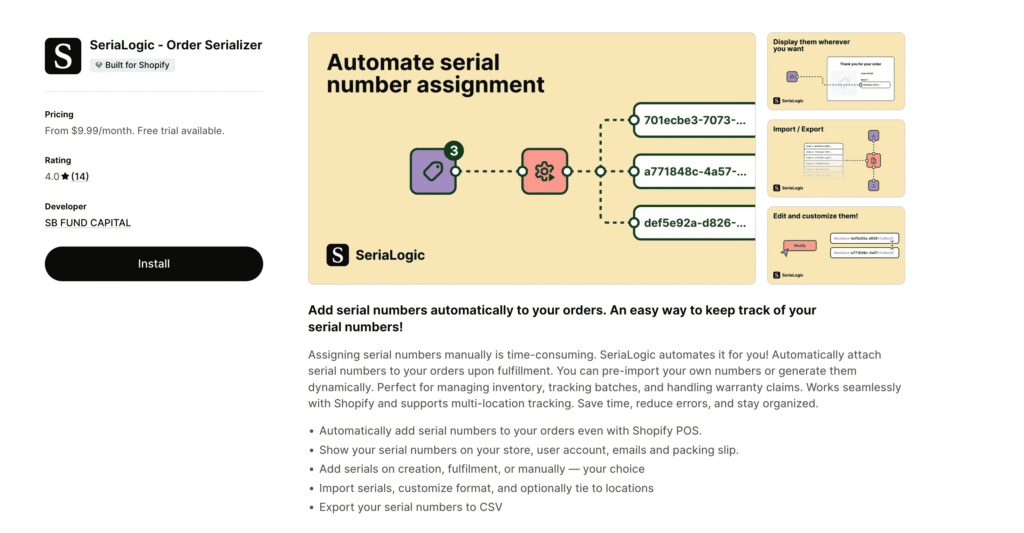
SeriaLogic is not a warranty management app. It is a serial number automation tool, and it is one of the best in its category on Shopify. If your brand needs to assign, track, and manage serial numbers across Shopify orders, SeriaLogic handles that job efficiently.
The app automatically attaches serial numbers to orders upon fulfillment. You can pre-import your own serial numbers or generate them dynamically using custom formats with prefixes and suffixes. Serial numbers display on your storefront, customer accounts, email notifications, and packing slips. Shopify POS support means in-store orders get serialized too. Multi-location tracking lets you tie serials to specific inventory locations.
For brands in electronics, medical devices, outdoor equipment, and other industries where serial tracking is mandatory or operationally critical, SeriaLogic saves hours of manual work. Instead of typing serial numbers into spreadsheets or order notes, the app assigns them automatically and makes them searchable across your system.
SeriaLogic makes this list because serial number management is a foundational piece of warranty infrastructure. You cannot validate a warranty claim properly without knowing which serial number belongs to which customer and which order. SeriaLogic handles that layer. But it does not handle anything beyond it. There are no registration forms, no claims processing, no warranty lifecycle management, and no customer-facing portal.
The ideal use of SeriaLogic is alongside a full warranty management app. It handles the serialization layer while your warranty app handles registration, claims, and communication.
Best suited for: Shopify brands that need automated serial number assignment and tracking across online and POS orders. Best used in combination with a warranty management app.
Key Features
- Automatic serial number assignment at order creation, fulfillment, or manually
- Import existing serial numbers or generate new ones dynamically
- Custom serial format with prefix and suffix options
- Display serials on storefront, customer accounts, emails, and packing slips
- Shopify POS support for in-store serialization
- Multi-location serial number tracking
- CSV export for external reporting
- Order search by serial number
Pros
- Focused tool that does one thing well: serial number automation
- Shopify POS integration covers both online and in-store orders
- Built for Shopify badge confirms native integration quality
- Responsive developer support mentioned consistently in reviews
- Saves significant manual time for brands with serialized inventory
Cons
- Not a warranty management app: no registration, no claims, no warranty tracking
- Must be paired with another app to cover the warranty lifecycle
- Smaller app with a limited review base
- Some reviews note the workflow requires extra steps compared to native Shopify features
- Search functionality for serial numbers was initially missing (has since been added)
Pricing: Free trial available. Paid plans available (contact developer for current pricing).
7. Warranly: Self-Managed Extended Warranty Upsells With Zero Commissions
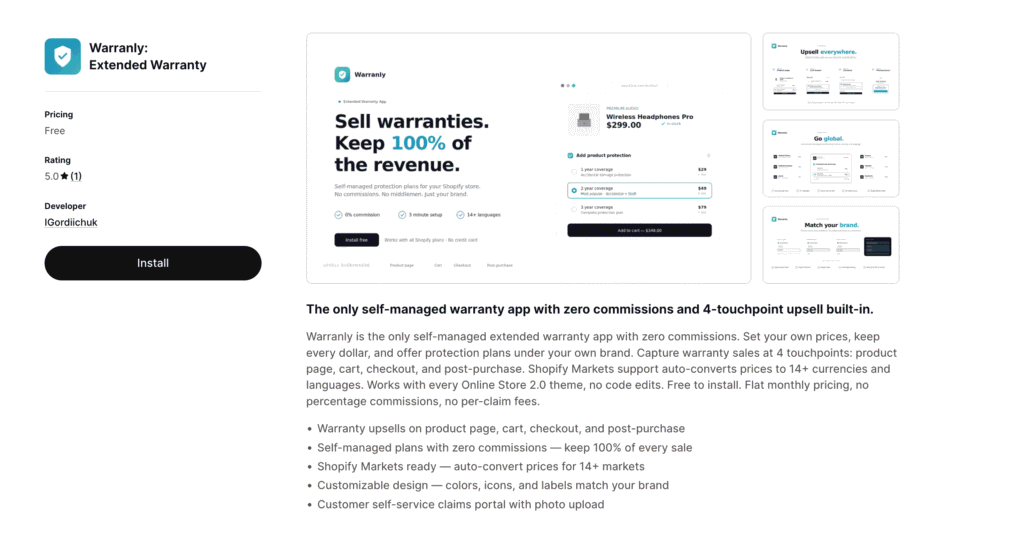
Warranly is the newest app on this list and takes a focused approach: let Shopify merchants sell self-managed extended warranty plans and keep 100% of the revenue with zero commissions. No third-party warranty provider. No revenue sharing. You create the plans, set the pricing, and handle the claims yourself.
The app offers warranty upsells across four touchpoints: product page, cart, checkout, and post-purchase. Multi-market warranty pricing with auto-converted currencies makes it usable for international stores. The widget is customizable with multiple themes, so it can match your store’s look and feel.
The value proposition is straightforward. Third-party warranty providers like Extend or Mulberry take a significant cut of every warranty sold. Warranly lets you skip the middleman. For brands selling products with a low claims rate, self-managed warranties can be highly profitable because you keep the full premium and only pay out on the claims that actually come in.
The trade-off is that Warranly is purely a warranty sales tool. It does not manage the warranty lifecycle after the sale. There is no product registration system, no claims management, no customer self-service portal, and no analytics. When a customer actually needs to file a claim on a warranty they purchased through Warranly, you will need a separate process or app to handle it.
Warranly is also brand new with no reviews yet, which means there is no community feedback on reliability, support quality, or long-term stability. For merchants willing to be early adopters and who primarily need a clean way to sell warranty plans, it is worth testing. For those who need a proven, full-lifecycle warranty solution, the lack of track record is a real consideration.
Best suited for: Shopify merchants who want to sell self-managed extended warranties as a revenue stream, keep 100% of the revenue, and are comfortable managing claims through a separate process.
Key Features
- Self-managed extended warranty plans with zero commissions
- Upsells at four touchpoints: product page, cart, checkout, and post-purchase
- Multi-market pricing with automatic currency conversion
- Customizable widget themes (multiple color schemes and dark mode)
- Full revenue retention with no third-party provider involvement
Pros
- 100% revenue retention on warranty sales with no commissions or revenue sharing
- Multiple upsell touchpoints maximize attachment rate
- Multi-market and multi-currency support out of the box
- Free to use with no monthly subscription cost
- Clean, focused tool that does warranty upsells without unnecessary complexity
Cons
- Brand new app with zero reviews and no established track record
- No product registration, claims management, or warranty lifecycle tools
- No customer self-service portal or claim tracking
- No analytics or reporting on warranty performance
- Handling claims requires a completely separate tool or manual process
- Self-managed warranties carry legal and compliance considerations that the app does not address
Pricing: Free.
How to Choose the Right Warranty App for Your Shopify Store
The right warranty app depends on what your store actually needs. Here is a practical framework.
- If you sell through multiple channels (Shopify + retail + marketplaces): You need omni-channel registration that captures offline buyers through QR codes and online buyers through your store. Dyrect is the only app on this list that covers both channels in one system. Industries like electronics, home appliances, kitchen equipment, and outdoor gear typically sell through mixed channels and benefit most from this approach.
- If you are a small store that just needs basic registration and claims: Propel gives you a clean, affordable setup at $9.95/month. My Product Registration offers deeper form customization at $15/month. Both handle the core job without overwhelming your team.
- If your primary goal is selling extended warranties for revenue: Webkul lets you display and sell warranty plans on product pages. Warranly offers the same with zero commissions. Neither manages the warranty lifecycle after the sale, so factor in how you will handle claims.
- If your real problem is returns, not warranties: AfterShip Returns & Exchanges is the right tool. It automates the entire return process with exchange-first workflows, but it is not a substitute for warranty registration and claims management.
- If you need serial number tracking as part of your warranty process: SeriaLogic handles serialization. Pair it with a warranty management app for full coverage.
- If you want one platform that covers registration, claims, analytics, upsell, and integrations: Dyrect covers the broadest scope in a single Shopify warranty app. For brands that treat warranty management as a serious operational and revenue function, rather than an afterthought, that breadth matters.
The right question is not “which app has the most features” but “which app solves the specific warranty problem my store has today, and can grow with us as we scale.”
Frequently Asked Questions
What is warranty management automation?
Warranty management automation uses software to handle product registration, claim validation, eligibility checks, and customer updates automatically, reducing manual work and speeding up warranty processing.
How does warranty registration improve customer retention?
Warranty registration helps brands identify product owners, build first-party customer data, and stay connected through personalized support, offers, and extended warranty opportunities, increasing repeat purchases.
How do warranty claims work on Shopify?
Customers submit a claim through a warranty portal or form. The app verifies eligibility, creates a support ticket, and guides the claim through repair, replacement, or approval while keeping customers updated.
Can I manage warranties for products sold outside Shopify?
Yes, if your warranty app supports omni-channel registration. Features like QR codes and standalone registration forms let customers from retail stores, marketplaces, and distributors register their products.
Are extended warranties profitable for Shopify stores?
In most cases, yes. Since claim rates are typically lower than warranty sales, extended warranties can generate additional revenue, especially for brands with reliable products.
What information should a warranty registration form collect?
A warranty form should collect customer details, product information, purchase date, serial number, proof of purchase, and sales channel to simplify claims and reduce fraud.
How long does it take to set up a Shopify warranty app?
Most Shopify warranty apps can be installed within minutes. Complete setup, including branding, warranty rules, and registration forms, usually takes one to three hours.
What’s the difference between a warranty app and a returns app?
Returns apps manage refunds and exchanges shortly after purchase, while warranty apps handle product registration, warranty coverage, repairs, replacements, and long-term claims.
How can I prevent fraudulent warranty claims?
Use serial number validation, proof of purchase, and customer verification during registration. Monitoring duplicate claims and suspicious activity further reduces warranty fraud.
Can warranty data help improve products?
Yes. Warranty data highlights recurring defects, product failures, and manufacturing issues, helping brands improve product quality and reduce future claims.
